
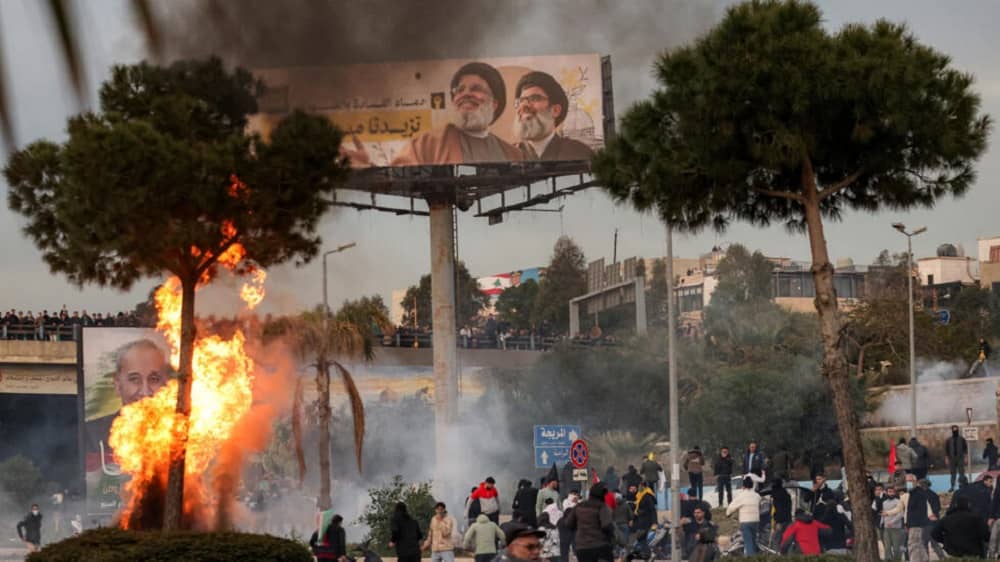
Clashes in the streets of Beirut. A billboard displays images of Hezbollah leader Hassan Nasrallah and Iran’s Supreme Leader Ali Khamenei
Violence erupted near Beirut’s Rafik Hariri International Airport on February 15 as clashes broke out between the Lebanese Army and Hezbollah supporters, following the Lebanese government’s controversial decision to ban Iranian flights from landing in the capital. The confrontation underscores escalating tensions between the Iran-backed militant group and Lebanon’s security forces amid growing public and political resistance to Tehran’s influence in the country.
According to reports from Monte Carlo Doualiya, the crisis began when Hezbollah organized a mass protest blocking access to the airport in response to Lebanese authorities refusing landing clearance to two Iranian planes. What started as a demonstration quickly turned violent as protesters attempted to breach security barriers, resulting in clashes with army personnel. The violence led to injuries among 23 soldiers, including three officers, as security forces deployed tear gas to disperse the crowd, citing a breach of prior agreements to maintain a peaceful protest.
In a statement published by Asharq Al-Awsat, Hezbollah condemned the army’s actions, describing the use of tear gas as an “unjustified provocation” and calling for an urgent investigation into what they labeled an assault on peaceful demonstrators. The party also demanded the government reverse its decision to ban Iranian flights, arguing that Lebanon must resist external pressures.
#Iran News: #Hezbollah Supporters Protest After Lebanese Authorities Block Iranian Flighthttps://t.co/bEtRKVJXht
— NCRI-FAC (@iran_policy) February 14, 2025
Despite Hezbollah’s protests, Lebanese authorities reaffirmed their decision on February 16, announcing that Iranian flights would remain suspended until at least February 18. The move triggered diplomatic repercussions, with Iran responding by blocking Lebanese planes from repatriating stranded Lebanese citizens from Tehran. This tit-for-tat escalation has further complicated Lebanon’s already fragile political landscape.
In response to the violent protests, the Lebanese Army launched security operations in Hezbollah-controlled areas of southern Beirut, including Burj al-Barajneh, leading to multiple arrests. Reports from local sources indicate that gunfire and explosions were heard in these neighborhoods, exacerbating concerns over rising instability in Hezbollah strongholds. Video footage circulating online appears to show security forces apprehending demonstrators, with speculation that some detainees may have ties to Hezbollah’s leadership.
Political analysts suggest that the Lebanese government’s firm stance signals a significant shift in its approach to Hezbollah. Prime Minister Nawaf Salam and President Joseph Aoun’s administration have taken a more assertive stance against the militant group, marking a departure from past policies that often accommodated Hezbollah’s influence in national affairs.
#Iran News: #Lebanon Intensifies Airport Inspections to Block Iranian Cash Transfers to Hezbollahhttps://t.co/fCa4Lb52E2
— NCRI-FAC (@iran_policy) February 10, 2025
Observers quoted in Asharq Al-Awsat believe this development is part of a broader trend, with Hezbollah facing increasing resistance not only in Lebanon but also in Iraq, Syria, and Yemen. The growing pushback from Lebanese state institutions—backed by the army’s decisive actions—suggests a weakening of Hezbollah’s long-standing grip on Lebanon’s security matters. As the government asserts its sovereignty, Hezbollah finds itself in one of its most precarious positions in years.

MEK Iran (follow us on Twitter and Facebook), Maryam Rajavi’s on her site, Twitter & Facebook, NCRI (Twitter & Facebook), and People’s Mojahedin Organization of Iran – MEK IRAN – YouTu