
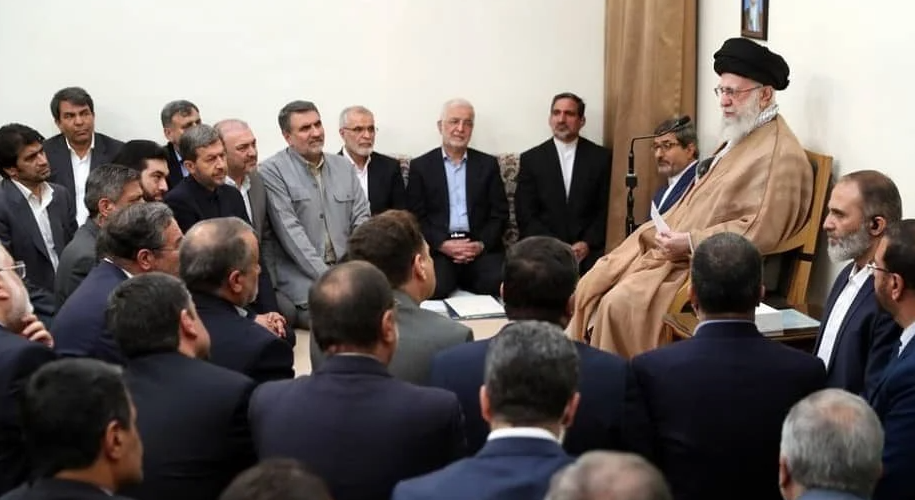
Iran regime’s Supreme Leader Ali Khamenei addresses governors and Interior Ministry officials on May 28, 2025
In a rare and telling moment, Iran’s Supreme Leader Ali Khamenei has urged state officials to “go among the people” and “listen patiently, even if their words are harsh.” Though cloaked as advice, his message is a veiled acknowledgment of the deep crisis engulfing the Islamic Republic. This call for face-to-face engagement is not a sign of reform, but a tactic to manage growing unrest.
On June 7, Khamenei addressed a gathering of governors and Interior Ministry officials, urging them to show warmth and patience toward an increasingly disillusioned population. His comments come amid a surge of strikes and protests across Iran—truckers, bakers, teachers, retirees, and workers have mobilized in over 135 cities. The causes are clear: fuel shortages, inflation, power cuts, and an unsustainable cost of living. The regime’s response, however, has largely involved arrests and repression—not dialogue.
Khamenei's Hardline Stance on Nuclear Program Exposes Deepening Instability in #Iran’s Regimehttps://t.co/WemgYWvQiy
— NCRI-FAC (@iran_policy) May 20, 2025
Khamenei’s remarks betray a shift in tone. For decades, he dismissed dissenters as tools of foreign enemies, insisting that the Iranian people were united in support of the Islamic system. Now, he implores officials to “tolerate” frustration, a subtle admission that the regime can no longer ignore the depth of public anger—even within its own intelligence assessments.
Despite this rhetorical shift, Khamenei remains in denial. “There’s no special issue in the country,” he claimed, insisting Iran is “full of opportunities.” But the reality is bleak: rising unemployment, especially among the youth, widespread poverty, and a regime detached from the daily suffering of its people.
#Iran #News: Khamenei Rallies Basij Amid Fears of Protests and Pressure to Change His Regional Strategy https://t.co/L6oe0jFAu7
— NCRI-FAC (@iran_policy) November 27, 2024
Even more cynically, Khamenei recycled his metaphor of the “seven-headed dragon of corruption,” claiming to battle it while dismissing systemic graft as a “lie.” This rings hollow as billions have disappeared in scandals involving institutions under his direct control, including EIKO, the IRGC’s business networks, and other opaque entities.
While Khamenei warns officials against mixing public service with personal gain, many of his appointees enjoy immense wealth, foreign privileges, and exclusive contracts—far removed from the hardships faced by ordinary Iranians.
#Khamenei Warns of Internal Doubt as Nuclear Talks and Crises Shake #Iran’s Ruling Systemhttps://t.co/ozjsJI9KBh
— NCRI-FAC (@iran_policy) April 25, 2025
In truth, Khamenei’s speech was less about unity and more about survival. His plea to “listen” is not born of empathy, but of fear. As protests swell and legitimacy crumbles, the regime seeks to delay an inevitable reckoning. What Khamenei calls outreach is better understood as a last-ditch attempt to buy time.

MEK Iran (follow us on Twitter and Facebook), Maryam Rajavi’s on her site, Twitter & Facebook, NCRI (Twitter & Facebook), and People’s Mojahedin Organization of Iran – MEK IRAN – YouTu