
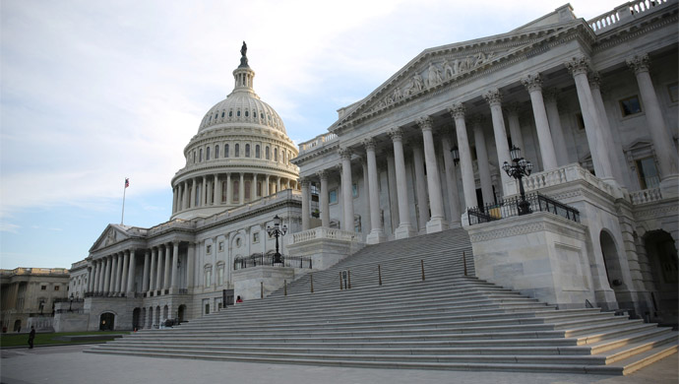
The U.S. Capitol building in Washington, D.C. | Martin Falbisoner, US Capitol east side, via Wikimedia Commons (CC BY-SA 3.0)
In a powerful show of support for the Iranian people’s struggle for freedom and democracy, the United States House of Representatives has overwhelmingly passed House Resolution 166 (H.Res. 166). With backing from 220 bipartisan members, the resolution affirms support for a democratic, secular, and non-nuclear Republic of Iran and strongly condemns the current regime’s terrorism, regional aggression, and internal repression.
This historic vote marks a growing consensus in Washington that the Iranian people’s call for change is legitimate, and that viable democratic alternatives deserve recognition and support. The resolution serves as a symbolic yet significant stand in favor of human rights and against authoritarian rule in Iran.
The broad support H.Res. 166 received underscores its importance. Eleven House committee chairs, leaders from six committees, and dozens of members from influential bodies such as the Foreign Affairs, Armed Services, Appropriations, and Intelligence Committees co-sponsored the resolution. This level of institutional backing highlights deep concern over Iran’s destabilizing role in the Middle East and reflects bipartisan agreement that U.S. foreign policy should support democratic movements in the region.
.@RepMcClintock: "#HRes116 is co-sponsored by @BradSherman and myself and joined by 150 members of the House of Representatives as original co-sponsors representing a broad cross-section of the House of Representatives, Democrats and Republicans alike."https://t.co/bqvlRBMYA1
— NCRI-FAC (@iran_policy) February 26, 2025
The resolution also echoes the voice of the Iranian people, particularly in light of major nationwide protests in 2018, 2019, and 2022. These uprisings, led primarily by youth and women, demonstrated widespread rejection of both religious tyranny and past monarchical rule. H.Res. 166 explicitly acknowledges this sentiment, affirming that the Iranian people seek a republic grounded in democracy and pluralism.
The resolution further states that Iranians have been denied their fundamental freedoms and clearly oppose all forms of authoritarianism. It highlights the people’s demands for governance based on their vote—affirming that political legitimacy must come from popular sovereignty, not the rule of a Supreme Leader or a monarch.
Critically, H.Res. 166 goes beyond condemnation and offers support for a practical vision of Iran’s future. It endorses the Ten-Point Plan proposed by Maryam Rajavi, the President-elect of the National Council of Resistance of Iran (NCRI). This plan promotes democratic values, free elections, gender and religious equality, a market economy, peaceful foreign policy, and the separation of religion and state.
The situation of the Iranian society is explosive. The mullahs are surrounded from all sides: by a society that is filled with anger and rebellion, by Resistance Units, and by selfless and rebellious youth. These resistance units are Iran’s freedom fighters and the driving force… pic.twitter.com/IuLUCwc1Fo
— Maryam Rajavi (@Maryam_Rajavi) February 26, 2025
The resolution notes that this vision has already gained wide international support, including endorsements from over 4,000 global parliamentarians, 130 former world leaders, and 80 Nobel laureates.
By formally recognizing this democratic roadmap, the U.S. House signals a clear stance: the future of Iran belongs to its people, and their vision for a free, democratic republic deserves global support.

MEK Iran (follow us on Twitter and Facebook), Maryam Rajavi’s on her site, Twitter & Facebook, NCRI (Twitter & Facebook), and People’s Mojahedin Organization of Iran – MEK IRAN – YouTu