
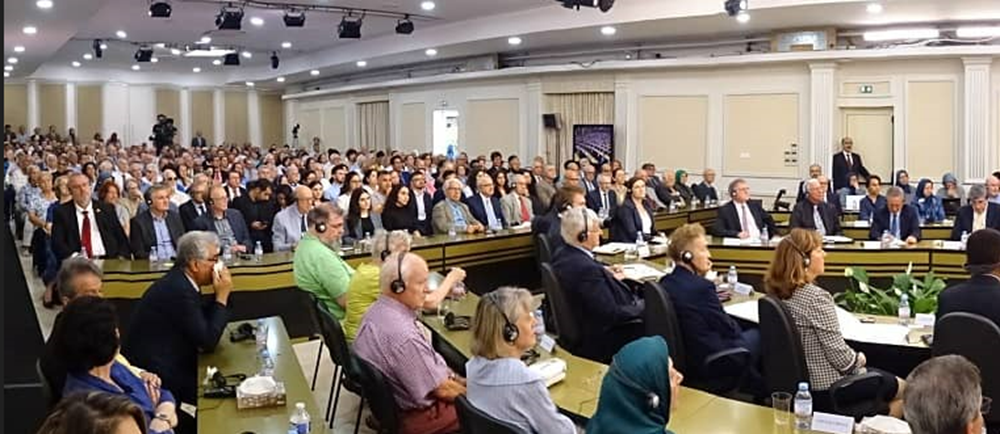
A significant international conference took place to address the atrocities and crimes against humanity perpetrated in Iran during the 1980s.
The event, held on Saturday, highlighted the massacre of political prisoners and members of the People’s Mojahedin of Iran (PMOI/MEK) and underscored the need for global accountability to end impunity for the masterminds behind these heinous acts.
The conference was attended by an impressive lineup of legal and human rights experts, including Professor Chile Eboe-Osuji, former President of the International Criminal Court (ICC), and Professor Leila Sadat, Special Adviser on Crimes Against Humanity to the ICC Prosecutor. They were joined by other esteemed figures such as Prof. William Schabas, renowned for his work on genocide, and Prof. Javaid Rehman, the UN Special Rapporteur on human rights in Iran.
Conference Featuring Distinguished Jurists, Legal Experts, and Eminent International #HumanRights Advocates
In his latest investigative report, Professor Javaid Rehman described the executions of 1981 and 1982, and the #1988Massacre, as “atrocity crimes,” epitomizing clear cases… pic.twitter.com/VuT3jRvrbn— Maryam Rajavi (@Maryam_Rajavi) August 24, 2024
Central to the discussions was the systemic execution of political prisoners in Iran during the early 1980s, with a particular focus on the 1988 massacre, which targeted members and sympathizers of the PMOI. Prof. Rehman presented a compelling argument for recognizing these acts as genocide, stating that the Iranian theocracy viewed the PMOI members as heretics, justifying mass executions and other brutal measures against them.
The conference also shed light on the ongoing persecution of Iranian resistance members. Prof. Steven Schneebaum highlighted the sham trials currently taking place in Tehran against 104 leaders and members of the Iranian Resistance, labeling these as mere pretexts for the regime to further its campaign of terror against dissenters both domestically and abroad.
Today, in our country, a regime rules, whose governance is predicated upon the suppression of #HumanRights, and whose survival is secured and guaranteed by the killing of people. pic.twitter.com/GfTK1YdNYR
— Maryam Rajavi (@Maryam_Rajavi) August 24, 2024
Ambassador Lincoln P. Bloomfield Jr. emphasized the role of misinformation in shaping Western perceptions of Iran and its resistance groups. He pointed out how media portrayals have often been manipulated by Tehran to discredit the PMOI and its affiliates, drawing parallels between the resistance’s actions and global precedents, such as the evacuation of children from war zones.
The conference reached a crescendo with a powerful address from Iranian opposition President-elect Maryam Rajavi of the National Council of Resistance of Iran (NCRI). She passionately called for the expansion of the global campaign against the death penalty, reiterating the NCRI’s longstanding opposition to executions. Rajavi advocated for a democratic Iran where the judiciary is independent, the rule of law prevails, and human rights are universally respected.
One of the most horrific instances of #HumanRights violations by the Iranian regime is the massacre of 30,000 political prisoners in 1988, with 90% of the victims being members of the PMOI. This book contains the names of 5,000 PMOI prisoners massacred in 1988. The… pic.twitter.com/z9YbzqQKoC
— Maryam Rajavi (@Maryam_Rajavi) August 24, 2024
Her call to action was clear: the international community must unite to hold Iran accountable and end the cycle of violence and repression that has plagued the nation for decades. The conference marked a critical moment in the global effort to bring justice to the victims of these atrocities and to promote a future free from the death penalty.

MEK Iran (follow us on Twitter and Facebook), Maryam Rajavi’s on her site, Twitter & Facebook, NCRI (Twitter & Facebook), and People’s Mojahedin Organization of Iran – MEK IRAN – YouTu