
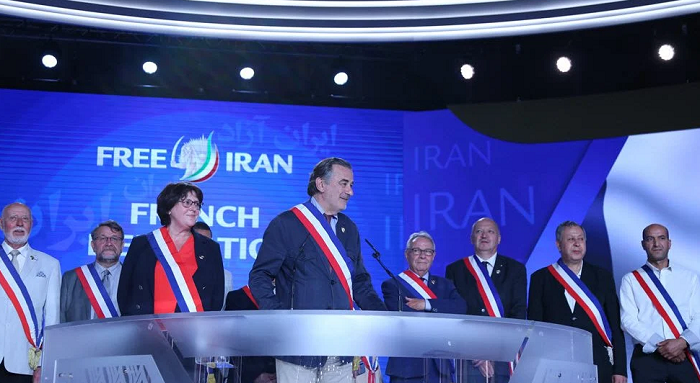
At the 106th Congress of Mayors in Paris, a unified plea echoed through the assembly halls as 580 French mayors signed a declaration urging the cessation of executions in Iran.
Prominent leaders such as Michaël Delafosse, Martine Aubry, and Jean-Michel Baylet lent their voices to this initiative, marking a pivotal moment in the international campaign for human rights. Spearheaded by the Committee of French Mayors for a Democratic Iran (CMFID) in collaboration with the Committee to Support Human Rights in Iran (CSDHI), the statement reflects growing alarm over the sharp increase in executions under Iran’s current administration.
According to Amnesty International, Iran accounted for 74% of all recorded executions globally in 2023. The situation has worsened under President Massoud Pezeshkian, with 386 executions reported in the first three months of his tenure alone. Among those executed was political dissident Reza Rasaei, whose death underscored the regime’s relentless suppression of dissent following the November 2022 uprising.
“Iran holds the grim record for the highest number of political executions and per capita killings worldwide,” the mayors stated. They condemned the regime’s use of executions as a political tool to instill fear and crush opposition. The mayors also voiced their support for Maryam Rajavi’s Ten-Point Plan for a democratic Iran, which prioritizes the abolition of the death penalty. Rajavi’s call for an end to executions was reinforced at an international jurists’ conference in Paris in August 2024, where she emphasized the urgency of global action.
📢 #Breaking Over 580 French mayors sign a declaration supporting @iran_policy's president-elect, Mrs. @Maryam_Rajavi ’s call to end executions in Iran, citing UN reports of the regime's crimes against humanity.
The statement condemns the regime’s political use of executions to… pic.twitter.com/lrKptJRzoV— SIMAY AZADI TV (@en_simayazadi) November 26, 2024
The mayors’ statement highlighted the international community’s responsibility to confront the Iranian regime’s systematic repression. They linked the lack of decisive global action to the regime’s continued reliance on executions to maintain control. Reports from the UN Fact-Finding Mission on Iran and UN Special Rapporteur Javaid Rehman—who characterized the 1988 massacre of 30,000 political prisoners as genocide—have added weight to calls for accountability.
Inside Iran, resistance is growing. Political prisoners in 20 facilities have launched a “No to Executions” campaign, holding hunger strikes every Tuesday since January 2024. Internationally, civil society groups and political figures have rallied to amplify their message. “The situation in Iran concerns us all,” the mayors declared, citing ongoing protests since Mahsa Amini’s death in September 2022. Led largely by women, these movements highlight the resilience of Iran’s people in the face of oppression.
🇮🇷 Peine de mort : 580 maires de France signent un appel pour dire « non aux exécutions » en #Iran https://t.co/eAQqh8QYsy
— Philippe Rioux (@technomedia) November 23, 2024
The collective action of French mayors reflects a broader consensus: the global community must act decisively to hold Iran accountable for its human rights abuses and support its citizens in their fight for justice and democracy.

MEK Iran (follow us on Twitter and Facebook), Maryam Rajavi’s on her site, Twitter & Facebook, NCRI (Twitter & Facebook), and People’s Mojahedin Organization of Iran – MEK IRAN – YouTu