
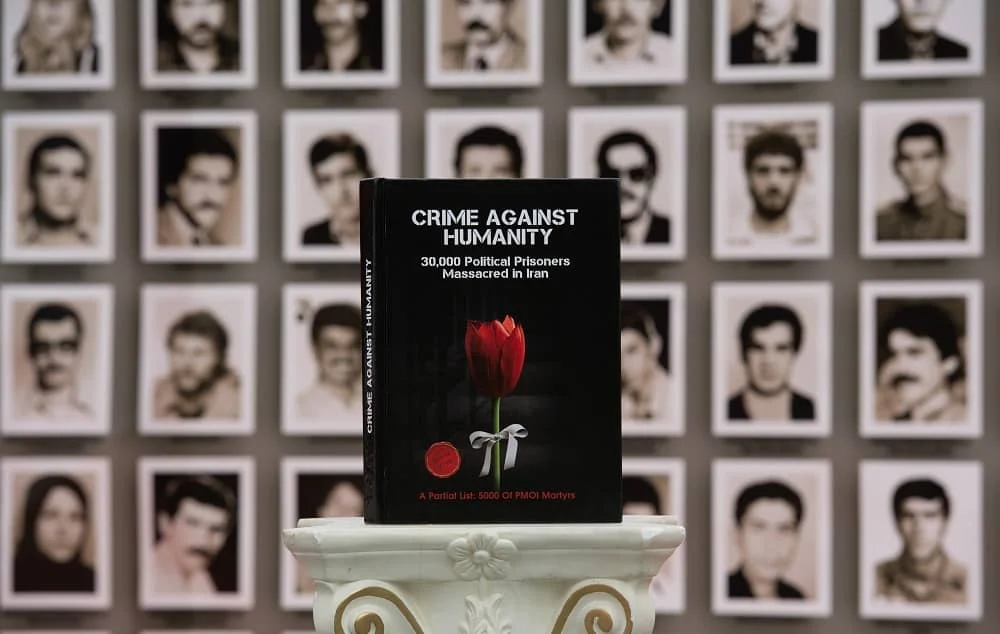
The clerical regime in Iran, notorious for its repressive governance and strategic manipulation of facts, has long sought to obscure the reality of one of the darkest chapters in its history the mass execution of thousands of political prisoners in the summer of 1988.
By attempting to link these executions to the Eternal Light Operation, conducted by the National Liberation Army (NLA) from July 26 to July 30, 1988, the regime has endeavored to frame what is arguably the largest genocide in Iran’s modern history as merely a response to an international conflict, thus evading accountability for its crimes against humanity.
To rewrite history, the regime has propagated the narrative that the executions were a reaction to a prison rebellion coinciding with the so-called “Mersad Operation,” the regime’s term for the NLA’s Eternal Light Operation. However, survivor testimonies and historical records suggest a different reality—one that paints a picture of premeditated and methodical genocide, ordered by Ayatollah Khomeini himself.
Masoumeh Kashani, a member of the People’s Mojahedin of Iran (PMOI/MEK), recently shared her insights into the preplanning of the massacre. According to Kashani, preparations for the executions began months before the NLA’s operation, with prisoners being systematically categorized based on their political affiliations as early as February 1988. This deliberate sorting of prisoners into groups deemed as threats, she argues, contradicts the regime’s narrative that the executions were a spontaneous response to rebellion.
Instead of upholding justice, the Iranian judiciary oppresses and violates human rights. We urge the international community and individual governments to provide accountability and pursue justice for the regime's many victims. pic.twitter.com/Mr0HpJuJ5g
— Matthew Miller (@StateDeptSpox) July 17, 2020
Kashani’s testimony is further corroborated by other survivors, such as Mahmoud Royaei, Hossein Farsi, and Majid Saheb Jam, who have recounted their harrowing experiences of being sorted and isolated in preparation for the massacre. These accounts reveal that the groundwork for the killings was laid well in advance, with prisoners being screened and selected for execution months before the actual event.
The true motive behind the massacre is further illuminated by Khomeini’s fatwa, which ordered the extermination of steadfast political dissidents within the regime’s prisons. Contrary to the regime’s claims, Khomeini’s decree does not mention the NLA’s military operations; instead, it targets those who remained loyal to the MEK, branding them as enemies of God and condemning them to death.
Despite the regime’s attempts to bury the truth, the legacy of the 1988 massacre endures. Efforts to seek justice and accountability continue, with survivors and new generations of Iranians refusing to let the memory of the victims fade. The clerical regime’s efforts to distort history have not succeeded in silencing the voices of those who demand justice, and the fight for truth and accountability remains as strong as ever.

MEK Iran (follow us on Twitter and Facebook), Maryam Rajavi’s on her site, Twitter & Facebook, NCRI (Twitter & Facebook), and People’s Mojahedin Organization of Iran – MEK IRAN – YouTu