
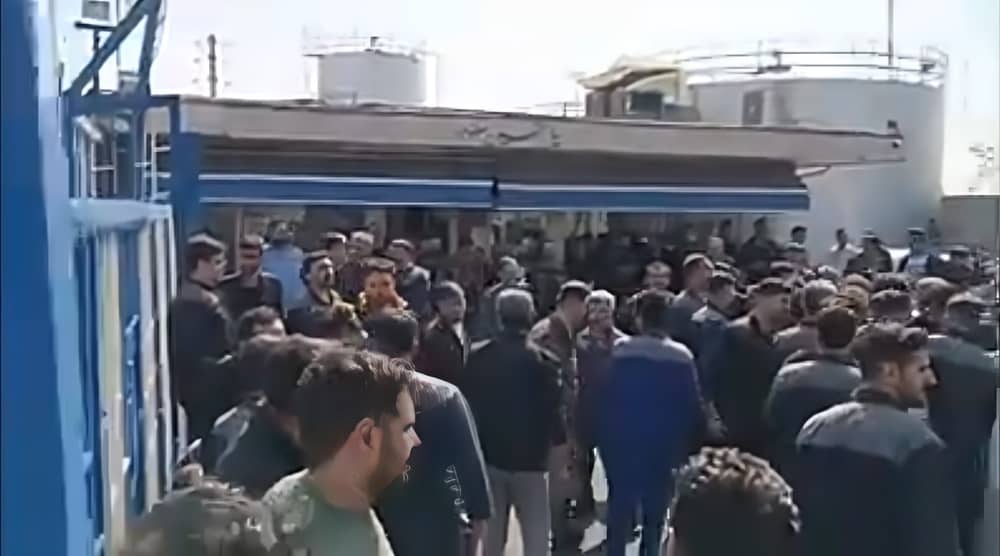
Workers from Mina Glass Factory, affiliated with the regime-controlled Mostazafan Foundation, protest in Qazvin, northcentral Iran, March 15, 2025
A new wave of protests has erupted across Iran, driven by mounting frustrations over economic hardship, environmental crises, labor rights, and political repression. Demonstrations spanning multiple cities reflect the growing discontent with the clerical regime’s handling of the country’s worsening socio-economic conditions.
On March 15, workers from Mina Glass Factory, linked to the regime-controlled Mostazafan Foundation, staged protests in Tehran and Qazvin, demanding fair wages and basic labor rights. The same day in Shiraz, members of the Qashqai tribe demonstrated against the confiscation of their traditional attire, underscoring the regime’s suppression of cultural freedoms. The situation escalated into clashes with security forces outside the governorate, highlighting increasing tensions over identity rights.
Political dissatisfaction was also evident in Varamin, Tehran Province, where PMOI Resistance Units confronted regime President Masoud Pezeshkian, chanting: “Resign and Leave, Varamin is Not Your Place.” This protest signals rising opposition to the political establishment.
Labor unrest continued as radiology personnel in Golestan province held demonstrations on March 15, demanding improved working conditions and highlighting the broader dissatisfaction among medical professionals.
March 15—Tehran and Qazvin, Iran
Protest rally by workers of Mina Glass Factory, affiliated with the state-run Mostazafan Foundation. Workers are protesting regime authorities ignoring their basic rights and keeping their wages low.#IranProtestspic.twitter.com/Zc45njBEhJ— People's Mojahedin Organization of Iran (PMOI/MEK) (@Mojahedineng) March 15, 2025
Environmental and agricultural grievances were at the forefront on March 14, as farmers from eastern and western Isfahan gathered with tractors to demand access to water from the drying Zayandeh Rud River. The water crisis has severely impacted farming communities, exacerbating tensions between the regime and rural populations. On the same day, PMOI Resistance Units in Zahedan, southeast Iran, conducted demonstrations rejecting both the Shah’s and the current regime’s rule, advocating for democratic governance.
Memorial gatherings were held on March 14 in multiple cities, including Tehran, Robat Karim, Tabriz, Sanandaj, Abdanan, Shiraz, Kermanshah, Amol, Pakdasht, Kerman, and Karaj, as families and friends honored fallen protesters. These events reinforced collective calls for justice and defiance against oppression.
PMOI Resistance Units in Zahedan reject the shah and mullahs’ dictatorships https://t.co/d3KypHFkCX
— People's Mojahedin Organization of Iran (PMOI/MEK) (@Mojahedineng) March 15, 2025
On March 13, protests in Baghmalek saw healthcare workers rally for better conditions, while in Ahvaz, shareholders of the Iran National Steel Industrial Group protested outside the National Bank, demanding accountability for alleged corruption. Demonstrations addressing housing affordability, employment stability, and resource allocation occurred in East Isfahan, Qazvin, and Kermanshah.
Additionally, electricity company operators in western Kermanshah protested against unstable employment conditions and unfair labor practices. The persistence and geographic spread of these protests underscore the regime’s increasing inability to address economic grievances and social injustices, contributing to a volatile situation that threatens to escalate further.

MEK Iran (follow us on Twitter and Facebook), Maryam Rajavi’s on her site, Twitter & Facebook, NCRI (Twitter & Facebook), and People’s Mojahedin Organization of Iran – MEK IRAN – YouTu