
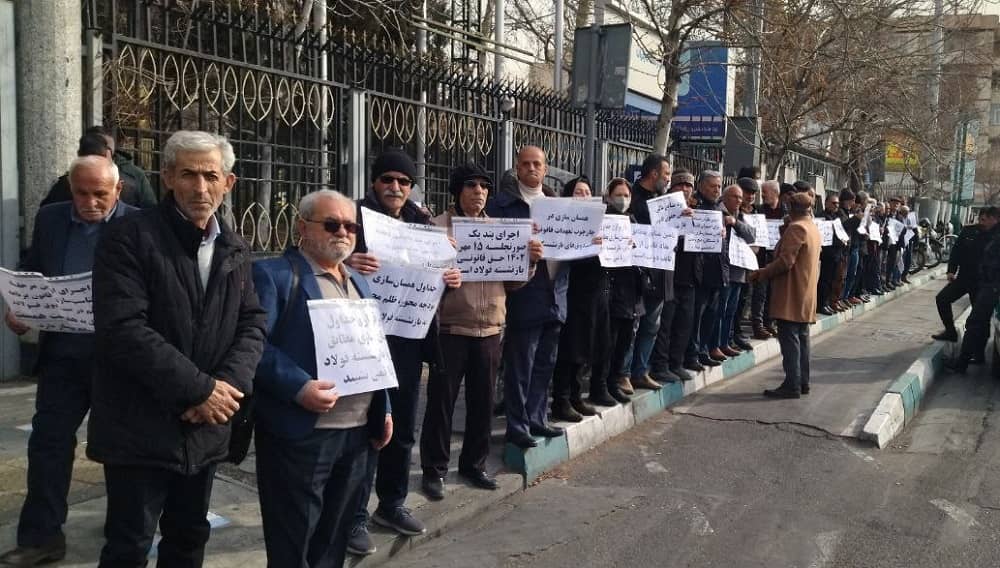
Retired steel workers in Tehran protested on March 4, 2025
Widespread protests erupted across Iran today as workers, retirees, healthcare professionals, farmers, and fishmongers took to the streets to demand their rights. The demonstrations, spanning multiple cities, highlight the escalating economic and social crisis gripping the country, as inflation, mismanagement, and deteriorating living conditions fuel public discontent. In the capital, Tehran, steel industry retirees rallied against the mismanagement of the Steel Pension Fund. Protesters condemned inadequate pensions and the government’s failure to implement pension equalization, chanting: “This level of injustice has never been seen by any nation.”
Similar protests unfolded in Shiraz, where telecommunications retirees gathered in large numbers to voice their frustrations. In central Iran, workers from Jahan Pars Company in Rafsanjan and farmers in Isfahan demanded better working conditions and fair wages, underscoring the widespread economic hardship faced by multiple labor sectors.
March 4—Shush, southwest Iran
Healthcare workers hold protest rally as regime authorities continue to ignore their demands for better working conditions and decent pay.#IranProtests pic.twitter.com/rPL28R65IJ— People's Mojahedin Organization of Iran (PMOI/MEK) (@Mojahedineng) March 4, 2025
Healthcare professionals also took to the streets in several cities, including Shush, Ardal, and Rasht, protesting deteriorating working conditions, stagnant wages, and unpaid benefits. Nurses and medical staff in Shush chanted, “Empty promises are enough; our tables are empty,” while their counterparts in Ardal vowed to continue demonstrations until their demands were met.
Meanwhile, in the southern port city of Bandar Abbas, local fishmongers protested against the forced destruction of their marketplace by government authorities. Many of them, now left without a source of income, chanted: “For 80 years, this has been our place—where should we go now?” The forced displacement of these workers has further exacerbated tensions.
March 4—Ardal, western Iran
Healthcare workers hold protest rally as regime authorities continue to ignore their demands for better working conditions and decent pay.#IranProtests pic.twitter.com/7wk5VvFqGA— People's Mojahedin Organization of Iran (PMOI/MEK) (@Mojahedineng) March 4, 2025
Iran’s ongoing economic crisis has pushed many citizens into increasingly desperate living conditions. Reports from state-affiliated media have highlighted alarming new trends, including the rise of “public bed rentals” in Tehran. Due to soaring rent prices, individuals now resort to renting a single bed for 100,000 tomans per night or 2 million tomans per month, with an additional entry fee of 20,000 tomans.
Additionally, medication shortages and surging drug prices have led to an increase in “prescription abandonment.” Hadi Ahmadi, a board member of Iran’s Pharmaceutical Association, admitted that three out of every ten customers in pharmacies leave without purchasing their prescribed medication due to unaffordability. Even President Masoud Pezeshkian acknowledged that large sums of subsidized foreign currency, intended for medicine imports, have vanished, contributing to worsening shortages and price hikes.
March 4—Bandar Abbas, southern Iran
Fishmongers rally to protest regime authorities destroying their markets and selling places.#IranProtestspic.twitter.com/xn8ndOQbuJ— People's Mojahedin Organization of Iran (PMOI/MEK) (@Mojahedineng) March 4, 2025
As protests intensify across Iran, the government faces mounting pressure from various sectors of society. With economic conditions deteriorating and public dissatisfaction reaching a boiling point, authorities must urgently address these grievances or risk further unrest in the days ahead.

MEK Iran (follow us on Twitter and Facebook), Maryam Rajavi’s on her site, Twitter & Facebook, NCRI (Twitter & Facebook), and People’s Mojahedin Organization of Iran – MEK IRAN – YouTu