
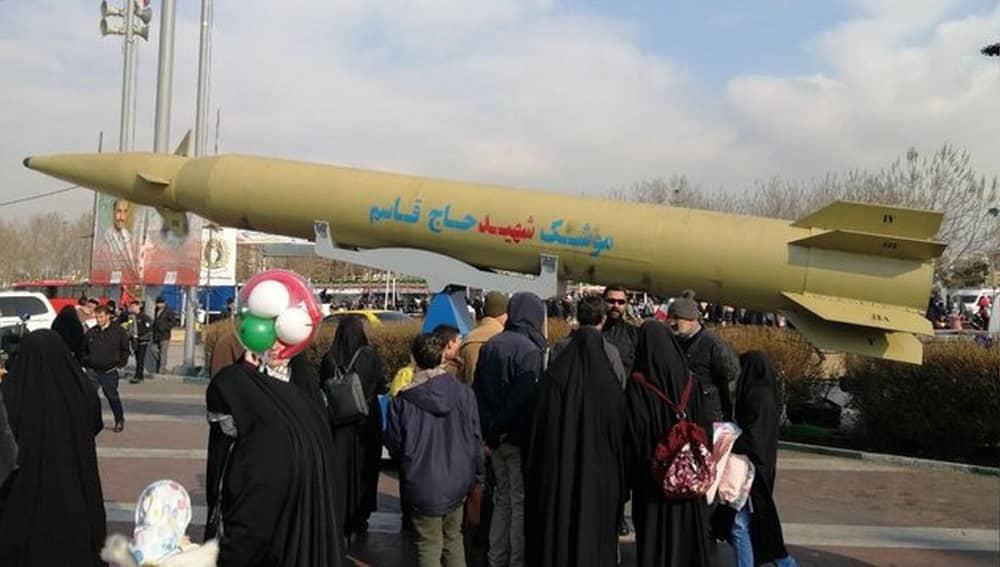
The ‘Haj Qasem’ ballistic missile on display during the state-staged march in Tehran on February 10, 2025
As the Iranian regime commemorated the 46th anniversary of the 1979 revolution, it deployed extensive state resources to project an image of strength. However, despite elaborate military displays, orchestrated rallies, and fiery rhetoric, the celebrations were overshadowed by deepening domestic unrest and mounting international pressures. Across major cities, state-organized demonstrations sought to reaffirm support for the government. In Tehran’s Azadi Square, President Masoud Pezeshkian delivered a defiant speech, asserting, “This is our Iran, and under the leadership of the Supreme Leader, we will stand against tyranny and oppression.” Yet, his remarks highlighted contradictions as he simultaneously condemned U.S. policies while acknowledging Iran’s diplomatic and economic isolation.
Foreign Minister Abbas Araghchi echoed these sentiments in Hamedan, attributing Iran’s economic struggles to a Western conspiracy. “We are facing a U.S. administration that has revived maximum pressure against Iran while falsely pretending to be open to dialogue,” he stated, reinforcing the regime’s long-standing narrative of external adversaries seeking to undermine the nation.
Parallels and Contrasts Between 1979 and #Iran’s New Revolutionhttps://t.co/nX0AgU8Cig
— NCRI-FAC (@iran_policy) February 10, 2025
Beyond the diplomatic posturing, Iranian military figures called for increased mobilization. Ali-Malek Shahkouhi, commander of the IRGC’s Neynava division, implored regime loyalists to remain steadfast: “If you are a fighter, a soldier, a cleric, a professor—where are you now? The battle of Valfajr 8 is happening today.” His urgent tone underscored concerns over waning support among regime backers.
Acknowledging growing disillusionment, Shahkouhi added, “If you face ridicule, if they mock you, if they call you names, know that this struggle has a price, and that price is worth it.” His comments reflected the regime’s struggle to maintain loyalty amid increasing public skepticism.
To reinforce anti-Western sentiment, the Tehran rally featured symbolic acts such as individuals in Trump and Netanyahu masks locked in a mock prison cell, along with the ritual burning of U.S. and British flags. The IRGC showcased drones and ballistic missiles, including the Khorramshahr missile, in a bid to signal military strength.
#IranProtests: Chants Against #Khamenei Erupt Across Cities on Revolution Anniversaryhttps://t.co/RdnsAhZyrY
— NCRI-FAC (@iran_policy) February 10, 2025
Yet, these displays failed to suppress signs of growing defiance. On the night of February 9, ahead of the anniversary, residents in cities like Tehran, Mashhad, Kermanshah, and Arak chanted anti-regime slogans such as “Death to the dictator” and “Khamenei, have some shame.” Viral footage of these protests further undercut the government’s narrative of national unity.
The anniversary coincided with worsening economic conditions, as the Iranian rial plummeted to a record low, with the U.S. dollar surpassing 94,000 tomans. Diplomatic talks between Tehran and Washington remained stalled, with Supreme Leader Ali Khamenei dismissing negotiations as neither “rational” nor “honorable.”
#Iran's Currency and Gold Prices Surge Amid Escalating Tensions with the Westhttps://t.co/0REyGIQsCt
— NCRI-FAC (@iran_policy) February 9, 2025
Even within the government, there were rare admissions of Iran’s precarious situation. Vice President Mohammad Reza Aref conceded, “Negotiations are a two-way street, and both sides must benefit. At this moment, we see no benefit in engaging with the U.S.” This acknowledgment signaled divisions within the regime on how to navigate its economic and diplomatic crises.

MEK Iran (follow us on Twitter and Facebook), Maryam Rajavi’s on her site, Twitter & Facebook, NCRI (Twitter & Facebook), and People’s Mojahedin Organization of Iran – MEK IRAN – YouTu