
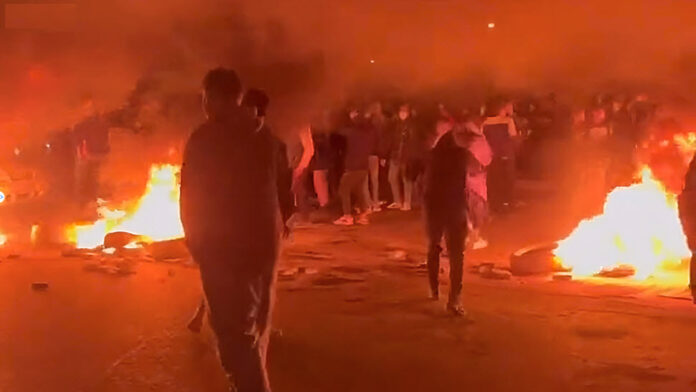
According to latest reports protesters in at least 220 cities throughout Iran’s 31 provinces have taken to the streets for 62 days now seeking to overthrow the mullahs’ regime. Over 550 have been killed by regime security forces and at least 30,000 arrested, via sources affiliated to the Iranian opposition PMOI/MEK.
Iran’s ongoing uprising, now in its 62nd day, reached a dramatic turning point on Tuesday as citizens across the country commemorated the third anniversary of the November 2019 protests. The anniversary served not only as a reminder of past resistance but also as a rallying cry that has intensified current demonstrations against the mullahs’ regime.
Protests have erupted in at least 220 cities, with demonstrators in Tehran, Sanandaj, Mashhad, Tabriz, Isfahan, and many others staging strikes, rallies, and blockades. Reports indicate that over 550 protesters have been killed and more than 30,000 detained, with the People’s Mojahedin of Iran (PMOI/MEK) publishing the names of 402 martyrs. The surge of civil disobedience this week coincides with strikes by shop owners and even workers at a major steel mill in Isfahan, signaling widespread participation across multiple sectors of society.
In Kamyaran, a powerful moment of solidarity emerged when citizens gathered to honor Foad Mohammadi, a protester shot dead by security forces two days ago. Despite authorities forcing his family into a secretive nighttime burial to prevent public mourning, residents convened the following morning in a defiant rally. Slogans such as “Death to Khamenei!” and “Game over!” reverberated across cities, directly challenging the supreme leader and his administration.
November 16 – Kamyaran, western #Iran
Locals rallied outside the home of Foad Mohammadi in an anti- regime rally.
Mohammadi, father of two, was shot and wounded on Monday night, and died in a hospital.#IranRevolution2022#مرگ_بر_ستمگر_چه_شاه_باشه_چه_رهبرpic.twitter.com/pZrfwrq0NY— People's Mojahedin Organization of Iran (PMOI/MEK) (@Mojahedineng) November 16, 2022
In Tehran, the protests have been marked by significant clashes. Demonstrators in the historic Metal Bazaar and at Shush Square resisted heavy security measures, including teargas and live ammunition. In one instance, protesters at a metro station were fired upon by security forces, yet the resistance continued unabated. Student-led rallies also spanned a dozen universities, including Ahvaz Jondi Shapur and Tehran Tarbiat Modares Universities, further highlighting the deep-rooted discontent among Iran’s youth.
The demonstrations, sparked by the brutal death of Mahsa Amini—a 22-year-old woman who died after being beaten by the morality police—have evolved into a broader call for an end to systemic repression. Videos and eyewitness accounts from cities like Sanandaj and Izeh show security forces resorting to violent crackdowns even as protesters set fire to regime buildings and block roads to hinder further military interventions.
In the beginning of the 3rd month of Iran uprising, the brave women men and youths of Iran held demonstrations, strikes, and protests in more than 50 universities and 50 bazaars across the country, renewing their pledge with the martyrs of the November 2019 uprising#IranProtests pic.twitter.com/MQVMJc95JV
— Maryam Rajavi (@Maryam_Rajavi) November 15, 2022
Iranian opposition President-elect Maryam Rajavi of the National Council of Resistance of Iran (NCRI), lauded the protesters’ courage, stating, “The brave women, men, and youths of Iran have renewed their pledge to overcome religious fascism with their sacrifices.” As the international community watches closely, the intensity and spread of these protests may well determine the future of Iran’s democratic aspirations.

MEK Iran (follow us on Twitter and Facebook), Maryam Rajavi’s on her site, Twitter & Facebook, NCRI (Twitter & Facebook), and People’s Mojahedin Organization of Iran – MEK IRAN – YouTu