
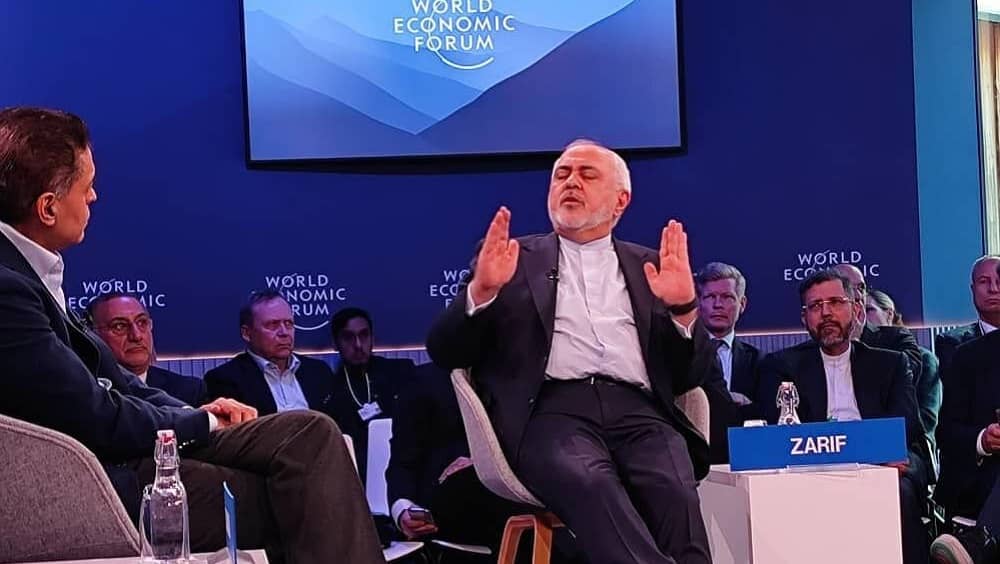
Iranian regime Deputy for Strategic Affairs Mohammad Javad Zarif speaking at the World Economic Forum, January 2025
In a high-stakes appearance at the World Economic Forum in Davos, Mohammad Javad Zarif, Deputy Strategic Advisor to Iranian President Masoud Pezeshkian, attempted to counter growing international criticism of Iran’s policies. The move, orchestrated by Supreme Leader Ali Khamenei, underscores the regime’s ongoing efforts to navigate intensifying global scrutiny over its destabilizing activities and human rights violations.
Zarif, known for his diplomatic maneuvering, denied Tehran’s involvement in the October 7 attacks during a conversation with CNN’s Farid Zakaria. He claimed an alleged meeting with U.S. officials on JCPOA renewal had been sabotaged by the attacks. However, Zarif’s comments revealed contradictions; he dismissed Iran’s control over regional militias while simultaneously defending their ideological resistance, illustrating Tehran’s longstanding strategy of plausible deniability.
As various regime factions desperately try to deceive people into participating in the upcoming sham #elections, remember this: On Aug 21, 2019, months before the 2019 uprising, then-FM Javad Zarif claimed the majority support the clerical dictatorship, citing over 70% turnout. pic.twitter.com/RuA0vIKfpd
— NCRI-FAC (@iran_policy) June 20, 2024
Zarif’s reputation as a master of rhetorical deflection was further highlighted by his remarks on Iran’s human rights record. He asserted the regime had relaxed enforcement of hijab laws, claiming women without headscarves now walked freely in Tehran. Yet, evidence contradicts these claims; since the 2022 protests following Mahsa Amini’s death, Iranian authorities have ramped up crackdowns on women defying dress codes, employing fines, arrests, and business closures. The UN has reported increased violence and systemic discrimination under these policies.
In addressing Iran’s nuclear ambitions, Zarif dismissed accusations of weapon development, asserting that if Iran desired a bomb, it would already possess one. He accused critics of fueling “Iranophobia and Islamophobia.” However, such statements have done little to assuage concerns over Tehran’s opaque nuclear activities and intentions.
Zarif’s Leaked Audio Confirm Iran Regime’s Terrorism and Diplomacy Go Hand In Hand#Iran #terrorism #Zarif https://t.co/BcA047U0Ng
— NCRI-FAC (@iran_policy) May 1, 2021
Zarif’s carefully crafted rhetoric reflects the regime’s broader strategy to project a moderated image while continuing its controversial policies. Despite opposition from within Iran’s political factions, Zarif’s appointment to represent the nation in Davos signals Khamenei’s determination to sustain Tehran’s narrative of defiance. This comes against the backdrop of decades of failed appeasement efforts by the international community, which critics argue have enabled the regime’s global terrorism and domestic repression.
The Davos appearance underscores the challenges of engaging with a regime defined by its actions rather than the conciliatory words of its diplomats. As tensions persist, Iran’s credibility on the global stage remains under sharp scrutiny.

MEK Iran (follow us on Twitter and Facebook), Maryam Rajavi’s on her site, Twitter & Facebook, NCRI (Twitter & Facebook), and People’s Mojahedin Organization of Iran – MEK IRAN – YouTu