
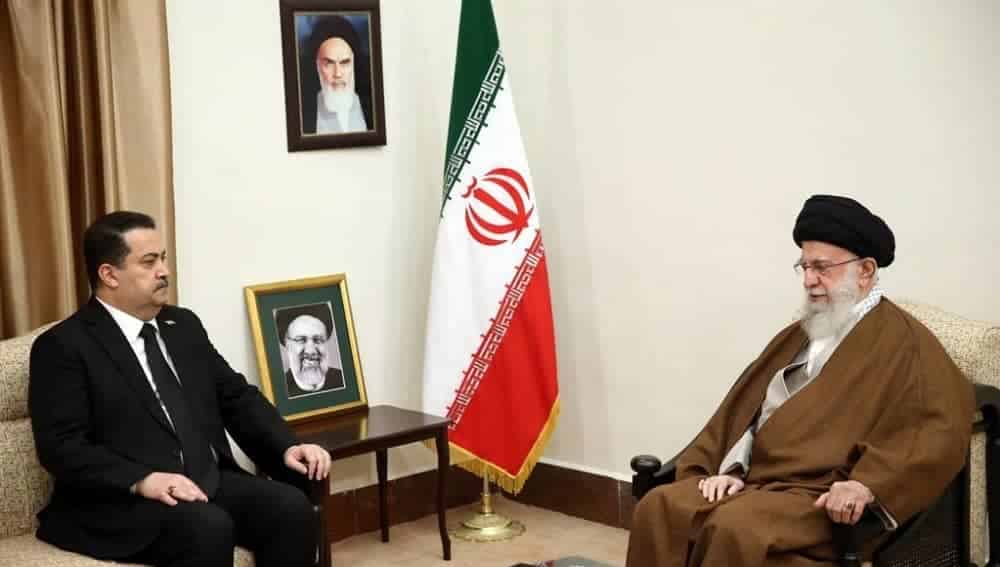
Iranian regime’s Supreme Leader Ali Khamenei met with Iraqi Prime Minister Mohammed Shia’ Al-Sudani on January 8, 2025
In a pivotal meeting with Iraqi Prime Minister Mohammed Shia’ Al-Sudani on January 8, Iran’s Supreme Leader Ali Khamenei urged for the bolstering of Iraq’s Popular Mobilization Forces (PMF), known as Hashd al-Shaabi, amid escalating international calls to disband pro-Iran militias. “Hashd al-Shaabi is one of the key elements of power in Iraq that must be preserved and strengthened,” Khamenei declared during the Tehran meeting.
The Supreme Leader also accused the United States of seeking to solidify its influence in Iraq, adding, “Evidence suggests that Americans are working to consolidate their presence in Iraq. This must be resisted.” Khamenei’s remarks come as Iraq grapples with balancing domestic and international pressures. The fall of Bashar al-Assad’s regime in Syria and the weakening of Hezbollah in Lebanon have left Tehran’s “Axis of Resistance” in a precarious position, exposing its network of proxies to increased scrutiny. Western powers, particularly the U.S., have reportedly hinted at potential military action if Iraq fails to curtail these militias’ influence.
Prime Minister Al-Sudani faces a complex challenge. On one hand, domestic voices, such as Iraqi advisor Ibrahim Al-Sumaidaie, emphasize the urgency of detaching Iraq from Tehran’s influence. “Iraq must no longer be linked to the ‘Axis of Resistance’ after the fall of Assad and Hezbollah’s weakening. We must dissolve these factions or risk this being imposed on us by force,” Al-Sumaidaie stated during a national broadcast.
#Iran News: State Media Warns #Iraq May Be Iran’s Last Stronghold After Losing Syriahttps://t.co/gfEjmYf47Z
— NCRI-FAC (@iran_policy) January 7, 2025
On the other hand, Khamenei’s firm stance highlights Iran’s unwillingness to relinquish its regional foothold. Analysts suggest this approach underscores Tehran’s defensive posture as it attempts to rally its remaining allies amid regional setbacks. Meanwhile, Esmail Qaani, commander of Iran’s IRGC Quds Force, recently visited Baghdad to explore alternative measures, possibly advocating for restructuring rather than disbanding the militias.
The divergent tones within Iran’s leadership were evident during Al-Sudani’s visit. While Khamenei stressed militias’ strategic importance, Iranian President Masoud Pezeshkian emphasized cooperation and security, suggesting internal debate over Iran’s regional strategy.
The international demand to disarm militias like Hashd al-Shaabi is part of broader efforts to curtail Tehran’s regional influence. With the collapse of Assad’s regime and diminished Hezbollah activity, Iran’s proxy network faces unprecedented challenges. Iraqi leaders’ growing insistence on distancing from Tehran reflects a shifting Middle Eastern dynamic.
A brief overview on how the #IRGCterrorists Quds Force rearranged the group perceived as the "Iraqi branch of Al-Qaeda" into the "Islamic State of Iraq" and then to #ISIS, helped cracking down on Iraqi and #Syrian uprisings and paved the way to create the PMF. pic.twitter.com/GwacqJhFPH
— NCRI-FAC (@iran_policy) January 18, 2024
As both nations navigate this changing landscape, Khamenei’s insistence on preserving Iran’s influence may signal more confrontation ahead, defining a crucial chapter in the evolving regional power balance.

MEK Iran (follow us on Twitter and Facebook), Maryam Rajavi’s on her site, Twitter & Facebook, NCRI (Twitter & Facebook), and People’s Mojahedin Organization of Iran – MEK IRAN – YouTu