
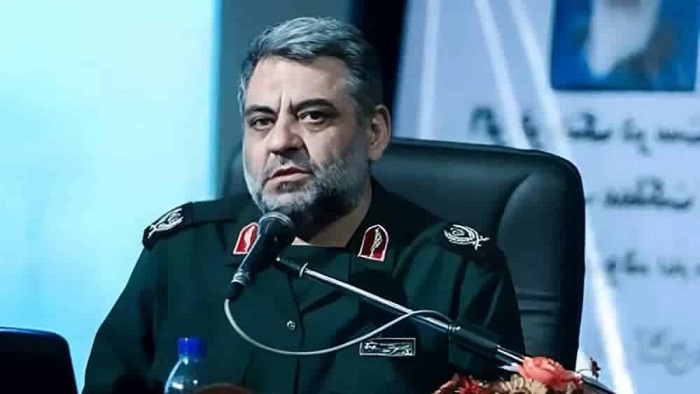
IRGC commander Behrouz Esbati conducting a speech
In an unprecedented admission, Brigadier General Behrouz Esbati of Iran’s Revolutionary Guards Corps (IRGC) has candidly acknowledged the significant challenges faced by Iran during the Syrian conflict. His remarks, revealed in a state-controlled media audio recording, deviate sharply from Tehran’s typical narrative of control and strength. This admission sheds light on systemic issues within Iran’s regional strategy and its impact on the broader Middle East.
Esbati, a senior commander and head of the Cyber Space Operations Base, recounted the dire state of Syria’s military during Bashar al-Assad’s regime’s final days. He painted a grim picture of widespread corruption, unpaid salaries, and morale collapse among Syrian forces. “Electricity shortages and poverty-driven corruption had consumed the Syrian military. Most soldiers in Aleppo fled even before opposition forces arrived,” Esbati stated, emphasizing the systemic disarray that hampered Assad’s forces.
In a pointed critique, Esbati accused Russia of undermining Iran’s efforts in Syria. He alleged that Moscow’s disabling of radar systems facilitated Israeli strikes on Iranian bases, citing attacks on critical headquarters like the martyr Sadeq intelligence center. He further accused Russia of prioritizing “Zionist regime” interests, particularly following the October 7 Hamas offensive. These allegations underscore strained ties between Tehran and Moscow, despite their shared involvement in Syria.
#Iran’s Strategic Collapse Evident in Syria’s Fall,” Reports #Russian Mediahttps://t.co/Y783NOcd1X
— NCRI-FAC (@iran_policy) January 2, 2025
Esbati revealed tensions with Assad, who resisted Iran’s call to launch an offensive against Israel after the “Storm of Al-Aqsa” operation. Assad’s refusal, citing his role as a logistical support platform rather than an active participant, highlighted divergent approaches within the so-called axis of resistance. Esbati’s account underscores the fractured alliances and strategic misalignments between Iran and its regional partners.
While Esbati acknowledged Iran’s losses, his narrative omitted the IRGC’s own shortcomings. Critics, including Ehsan Aminolraya of the National Council of Resistance of Iran (NCRI), argue that the IRGC’s internal chaos and plummeting morale were decisive factors in its failures. Aminolraya highlighted the disintegration of IRGC forces during key battles, emphasizing their unwillingness to fight as a critical weakness.
Esbati’s warnings against regional escalation reflect Tehran’s precarious position. While Supreme Leader Khamenei’s public rhetoric remains combative, Esbati’s tone suggests an internal acknowledgment of the regime’s vulnerabilities. Tehran’s dual strategy aims to project strength while mitigating risks of internal dissent and external attacks.
#IRGC's Failures in Syria Shows Its Inability to Save Khamenei in #Iran, NCRI Member Sayshttps://t.co/fzu781w7af
— NCRI-FAC (@iran_policy) January 5, 2025
The revelations about Iran’s setbacks in Syria highlight systemic vulnerabilities within the clerical regime. As Aminolraya noted, “The IRGC’s debacle in Syria exposes the regime’s broader fragility.” For Tehran, the collapse of Assad’s regime is not just a regional setback but a forewarning of existential challenges. The fallout underscores the regime’s struggle to maintain both its regional influence and internal stability, painting a picture of a state grappling with the consequences of its overreach.

MEK Iran (follow us on Twitter and Facebook), Maryam Rajavi’s on her site, Twitter & Facebook, NCRI (Twitter & Facebook), and People’s Mojahedin Organization of Iran – MEK IRAN – YouTu