
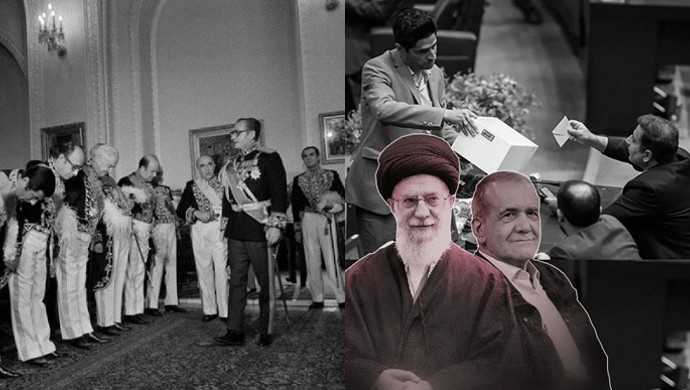
In a striking admission, Iranian regime president Masoud Pezeshkian’s recent speech before the parliament has once again underscored the sham nature of Iran’s electoral processes.
His confession, revealing the orchestrated selection of the cabinet under the direct supervision of Supreme Leader Ali Khamenei, highlights the absolute autocracy reigning within the Islamic Republic. This revelation strips the veneer of democracy the regime has long tried to project, drawing uncomfortable parallels with Iran’s monarchical past.
Pezeshkian’s statements come at a time of increasing internal and external pressure on the regime, exposing the hollow nature of the country’s elections. His words resonate deeply with Iran’s history under the Pahlavi monarchy, where elections were similarly manipulated to maintain the illusion of a democratic process. Reza Pahlavi, the father of the last Shah, notoriously referred to his handpicked parliament as a “stable,” reflecting his disdain for genuine democratic procedures. British diplomatic reports from the time described the parliament as a puppet institution, lacking any real independence or authority.
The practices initiated by Reza Pahlavi were carried forward by his son, Mohammad Reza, who continued to stage elections with predetermined outcomes, particularly after the 1953 coup against Prime Minister Mohammad Mossadegh. Hossein Fardoust, a high-ranking official in the Pahlavi regime, later recounted how parliamentary representatives were selected through a process controlled by a small, elite commission, ensuring that only those loyal to the Shah could gain office.
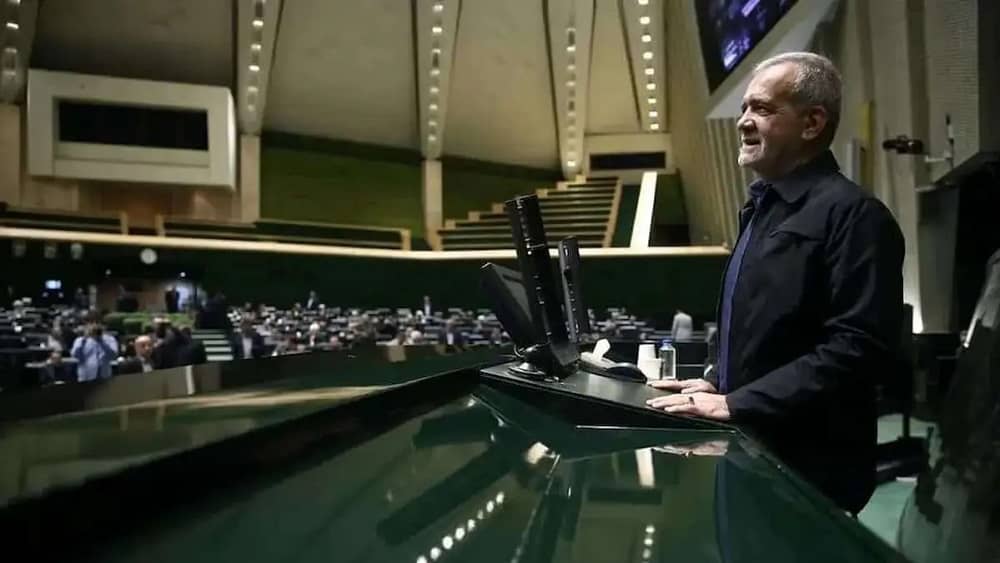
This pattern of autocratic control over elections has been perpetuated under the Islamic Republic, as Pezeshkian’s remarks illustrate.
Pezeshkian detailed how all critical decisions regarding cabinet appointments were made in coordination with Khamenei and the Islamic Revolutionary Guard Corps (IRGC), leaving no room for genuine political competition or independent decision-making. Pezeshkian even recounted how the Minister of Culture was forced into his position by a direct order from Khamenei, further underlining the Supreme Leader’s absolute control.
The Kayhan newspaper, a mouthpiece for Khamenei, expressed deep concern that these admissions have discredited the regime’s claims of democracy and parliamentary independence. In an article published on September 22nd, Kayhan warned that Pezeshkian’s words had provided ammunition to critics of the regime, further eroding public trust in Iran’s political institutions.
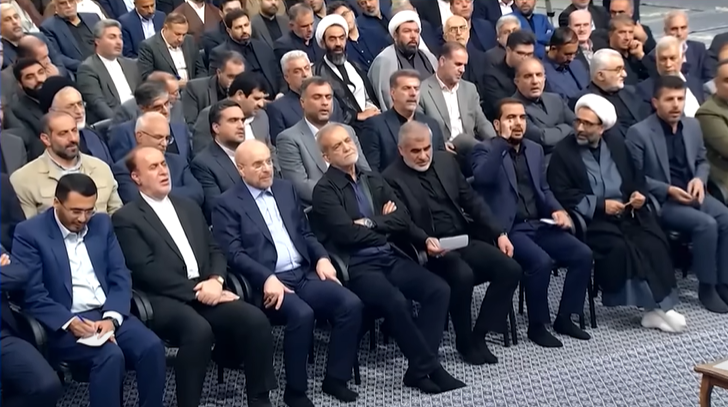
The fallout from Pezeshkian’s speech has been significant.
This incident has laid bare the facade of democracy that the Islamic Republic has maintained for over four decades. The parallels between the current regime and the dictatorial practices of the Pahlavi era are clear, reinforcing the perception that, despite the change in leadership, the fundamental lack of democratic governance in Iran remains unchanged.

MEK Iran (follow us on Twitter and Facebook), Maryam Rajavi’s on her site, Twitter & Facebook, NCRI (Twitter & Facebook), and People’s Mojahedin Organization of Iran – MEK IRAN – YouTu