
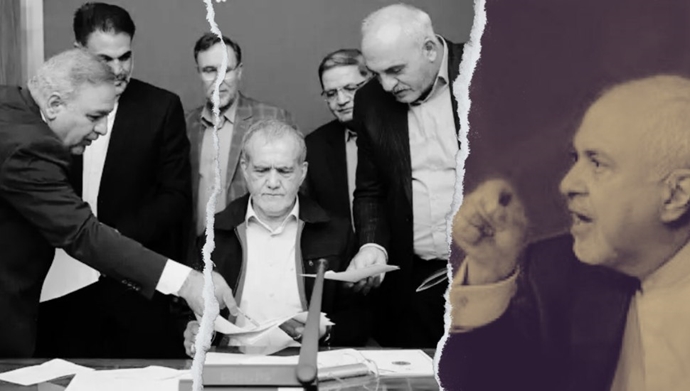
Recently, Masoud Pezeshkian, Iran’s newly appointed president, has ignited a firestorm within the regime’s political landscape.
During a parliamentary session on August 21, Pezeshkian revealed that every member of his cabinet had been pre-approved by Supreme Leader Ali Khamenei, shedding light on the controlled and undemocratic nature of Iran’s government. Pezeshkian’s admission was intended to secure parliamentary approval for his cabinet, but it had the unintended consequence of exposing the façade of Iran’s democracy. “I gave the entire list to the Leader. Everyone came here with coordination and agreement,” Pezeshkian declared, effectively reducing the parliament’s role to a mere formality.
This candid confession has been met with intense backlash from various factions within the regime, who fear the implications of such a revelation. Hossein Shariatmadari, editor-in-chief of the conservative Kayhan newspaper, was among the first to condemn Pezeshkian’s remarks. He labeled the statements as “unrealistic claims” that provided ammunition for the regime’s critics to undermine the legitimacy of Iran’s democratic institutions. Shariatmadari insisted that Pezeshkian retract his comments, arguing that they misrepresented Khamenei’s role and endangered the regime’s image.
Pezeshkian’s Cabinet Is Testament to #Khamenei’s Unquestioned Authority Over #Iran’s Governancehttps://t.co/vyebHqPZc0
— NCRI-FAC (@iran_policy) August 22, 2024
The criticism did not stop there. State-run media outlets and influential figures within the government expressed their discontent, accusing Pezeshkian of exploiting Khamenei’s authority to force his cabinet through the approval process. The IRGC-affiliated Javan newspaper reported objections from the Parliament’s Security Commission spokesperson, who rebuked Pezeshkian for implying that Khamenei’s endorsement was necessary for ministerial candidates.
The controversy has further deepened with MPs like Malek Shariati and Manan Raisi publicly questioning the legitimacy of the vote, suggesting that the parliament had effectively voted for “the Leader’s cabinet” rather than Pezeshkian’s. Editorials in publications such as Vatan-e Emrooz echoed these sentiments, describing Pezeshkian’s tactics as a “grave mistake” and calling for corrective measures.
However, not everyone within the regime views Pezeshkian’s transparency as a misstep. Ali Motahari, a former Deputy Speaker of Parliament, defended the president’s approach, praising it as an honest reflection of the power dynamics within Iran’s government. According to Motahari, Pezeshkian’s straightforwardness avoided “behind-the-scenes dealings” and laid bare the reality of the Supreme Leader’s influence.
Vetting #Pezeshkian’s Cabinet in #Iran Exposes Khamenei’s Grip and Regime Strifehttps://t.co/ZDQBgwc3zv
— NCRI-FAC (@iran_policy) August 20, 2024
This episode has unveiled the deepening authoritarianism within Iran’s clerical regime, where even the semblance of democratic processes is increasingly difficult to maintain. The infighting and public criticism following Pezeshkian’s admission underscore the fragility of a system that is struggling to contain internal dissent amid growing domestic unrest and international pressures.

MEK Iran (follow us on Twitter and Facebook), Maryam Rajavi’s on her site, Twitter & Facebook, NCRI (Twitter & Facebook), and People’s Mojahedin Organization of Iran – MEK IRAN – YouTu