
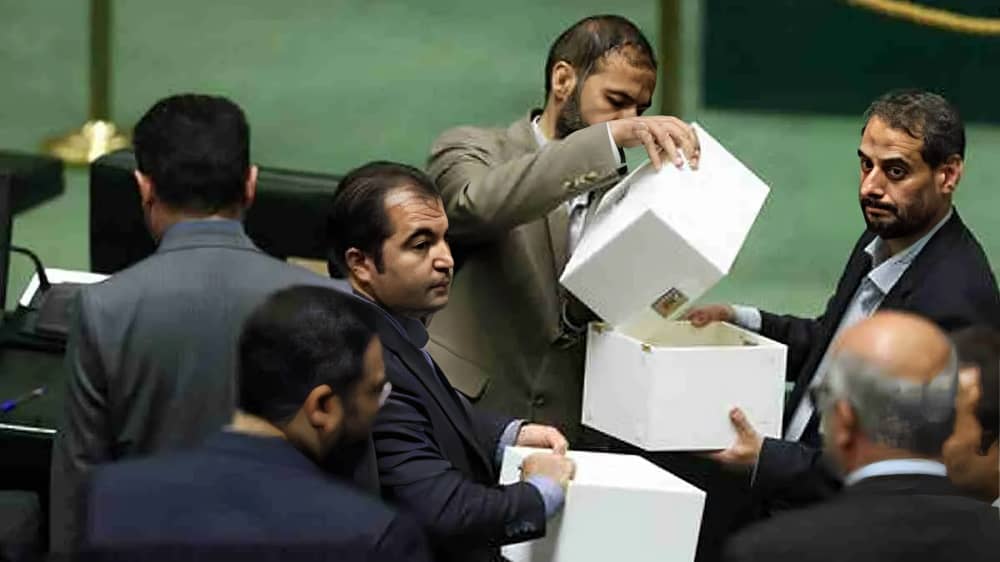
The recent election of the presidium in the Iranian regime’s parliament has shed light on significant voter fraud, underlining the systemic rigging and illegitimacy within the regime’s electoral processes
The 12th Islamic Consultative Assembly, or the Iranian regime’s Parliament (also known as Majlis), which began its session on May 28, faced unprecedented tension and allegations of fraud during the election of its Speaker and Presidium. Initially, Mohammad Bagher Ghalibaf was declared the Speaker with 198 votes, while Mojtaba Zonnouri and Manouchehr Mottaki received 60 and 5 votes, respectively. However, this election was tainted by multiple recounts and claims of irregularities.
The controversy further intensified during the selection of the Deputy Speakers. Hamidreza Haji Babaee and Ali Nikzad were announced as the first and second deputies, but their appointments ignited protests and accusations of fraud, prompting Ghalibaf to order a recount of all presidium votes. Although the recount did not change the Speaker candidates’ votes, it exposed discrepancies in the votes for the presidium observers. Gholamreza Nouri Ghazaltjeh, Alireza Salimi, and Jalil Mir-Mohammadi Meybodi retained their positions, but a tallying error was discovered, causing Nouri Ghazaltjeh’s votes to be counted twice, leading to a reduction of 31 votes.
Further fraud was uncovered in the election of the presidium secretaries. Initially, Mojtaba Bakhshipoor, Ahmad Naderi, Ruhollah Motofaker-Azad, Mojtaba Yousefi, Mohammad Rashidi, and Akbar Ranjbarzadeh were declared secretaries. However, the recount revealed changes in all these votes, resulting in Ranjbarzadeh losing his position. Abbas Papizadeh replaced him after their votes were tied, and a lottery was held to determine the outcome.
Hamid Rasaee, an influential MP, vehemently opposed the election results. On X (formerly known as Twitter), Rasaee disclosed more details about the electoral scandal, revealing that both Ranjbarzadeh and Papizadeh initially had 83 votes each, with Papizadeh winning the lottery. However, Rasaee pointed out that Ranjbarzadeh’s initial 83 votes were mysteriously increased to 84 after the recount, then reduced to 81, disqualifying him from the secretarial position.
Amid Dual Election Turmoil, Clash of Clans Escalate Within #Iran’s Regimehttps://t.co/nq8c6ZNMvA
— NCRI-FAC (@iran_policy) May 30, 2024
The day after, during the approval of the representatives’ credentials and amid Shariati and Tajgardoun’s altercations, Rasaee went on the offensive again. He confronted Ghalibaf, saying, “In the presidium election, you downplayed the issue in the closed session, saying nothing significant happened and that just one representative switched places. Mr. Ghalibaf, it’s not trivial; it’s like saying a 3 billion embezzlement is nothing!”
The election’s paper ballot format, involving only 290 votes, underscores the severity of the fraud. This situation raises profound concerns about the integrity of nationwide elections in Iran, where millions of votes are counted indirectly, without genuine voter oversight. The transparency and fairness of the electoral process are called into question, suggesting that if such blatant fraud can occur in a small, controlled environment, the potential for rigging and manipulation on the national scale is beyond measurement.This scandal not only questions the legitimacy of the current parliament but also casts a shadow over the entire electoral system in Iran, demanding immediate reforms to restore trust and integrity in the democratic process.

MEK Iran (follow us on Twitter and Facebook), Maryam Rajavi’s on
her site, Twitter & Facebook, NCRI (Twitter & Facebook),
and People’s Mojahedin Organization of Iran – MEK IRAN – YouTu