
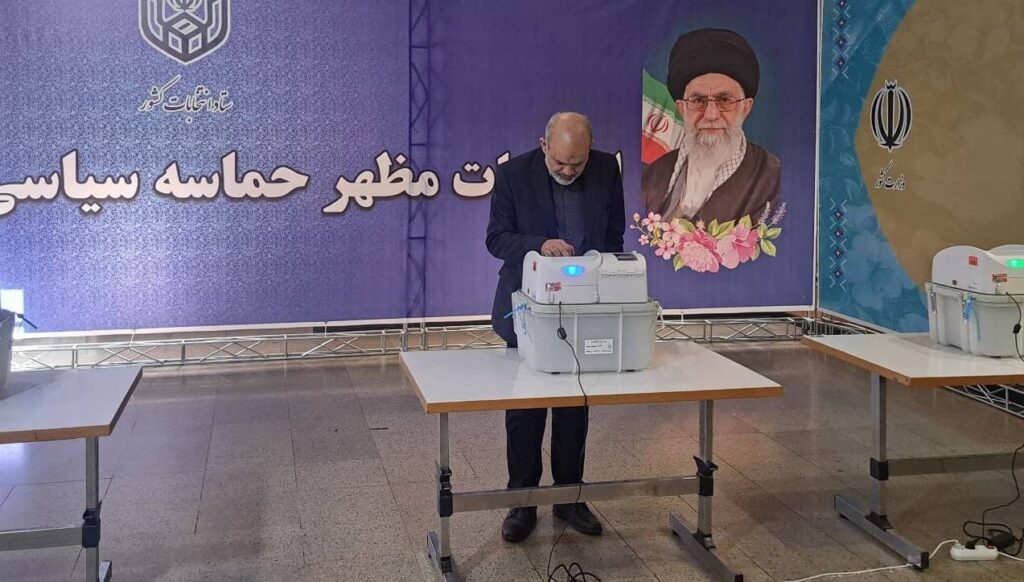
The second round of parliamentary elections in Iran has laid bare a critical predicament within the regime, a challenge that Supreme Leader Ali Khamenei has fervently tried to overcome by sidelining disobedient officials and attempting to consolidate his waning authority. However, this strategy has resoundingly failed.
Decades of governance built on propaganda and carefully crafted narratives are now crumbling, with state media and officials forced to admit not only to political, social, and economic challenges but also to the grave crisis of legitimacy their regime faces.
For years, Iranian resistance has asserted that the regime lacks popular support and maintains power through repression and torture. The uprisings since 2017, particularly the 2022 uprising, have underscored the regime’s unpopularity. The Iranian people’s demand for the overthrow of the regime and the establishment of a democratic republic was highlighted by the widespread slogan, “Death to the oppressor, be it the Shah or the leader.” The societal discontent has reached a point where even the regime’s staunchest allies acknowledge the lack of public participation in elections and the regime’s deceptive propaganda regarding voter turnout.
In the recent elections, the traditional playbook of the regime fell short. Ahmad Vahidi, Minister of Interior in Ebrahim Raisi’s cabinet, took to X (formerly Twitter) to proclaim the elections a success, stating, “Thanks to God, the people have forged an epic. I extend my heartfelt gratitude to all the honorable citizens.” This statement, however, was met with strong reactions within the regime.
#Iran’s Second Sham #Elections: Officials Clash for Power Amidst Public Push for Changehttps://t.co/AijLQT8qvj
— NCRI-FAC (@iran_policy) May 11, 2024
Mohammad-Javad Azari Jahromi, the Minister of Communications under Hassan Rouhani, sarcastically remarked that the “epic” referred to the 92% voter abstention in Tehran. Hesamoddin Ashna, an advisor to Rouhani, criticized the narrative, stating it deprived the government of critically assessing the situation. Abdolnasser Hemati, former governor of the Central Bank, questioned the portrayal of the elections as an “epic” when only 3 to 5 percent of the populace voted.
Reza Rashidpour, a former state television moderator, further ridiculed the Interior Minister’s use of the term “epic.” The backlash forced Vahidi to delete his post, but the criticism continued. Reports emerged that Bijan Nobaveh, a frontrunner candidate, secured only 3.5 percent of votes in Tehran, a figure viewed skeptically by many observers who believe actual participation was even lower.
The state-run newspaper Farhikhtegan and other media outlets reported dismal turnout figures, suggesting a crisis of legitimacy. Farhikhtegan noted an eight percent turnout in Tehran, highlighting the insignificant number of votes securing parliamentary seats. Jamaran News reported a significant drop in participation from the first to the second round of elections.
Why does #Khamenei fear his own sham elections? Why sideline allies like Fallahian, Salehi, Taeb and Rouhani? Is it about succession or survival? Explore in an 8-minute video on #IranElections. pic.twitter.com/byvOocmwR8
— NCRI-FAC (@iran_policy) February 13, 2024
The newspaper Resalat warned of a “catastrophe” and a “crisis,” emphasizing that 92 percent of eligible voters abstained, despite coercive measures to ensure turnout. This public outcry signifies a profound alarm for Khamenei and his cohorts. However, it is crucial to understand that these warnings are not about heeding the people’s voices but about anticipating the repercussions when the majority finally makes their voices heard. The Iranian regime’s crisis of legitimacy is now undeniable, with the latest elections serving as a stark indicator of the public’s overwhelming discontent.

MEK Iran (follow us on Twitter and Facebook), Maryam Rajavi’s on her site, Twitter & Facebook, NCRI (Twitter & Facebook), and People’s Mojahedin Organization of Iran – MEK IRAN – YouTu