
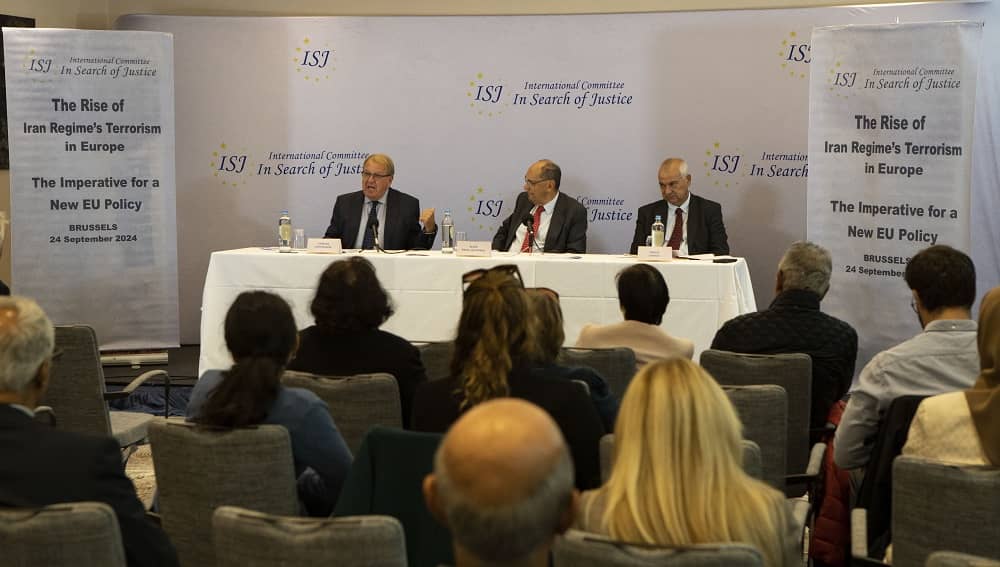
File photo: ISJ Committee members during a press conference held in September 2024
The International Committee in Search of Justice (ISJ) has voiced strong criticism over the recent release of two French hostages from Iran, expressing deep concern that the deal was struck at the expense of Iran’s democratic opposition. In a statement issued on March 20, the ISJ warned that Western governments, particularly France, may be enabling Tehran’s “hostage diplomacy” and undermining the National Council of Resistance of Iran (NCRI) and its President-elect, Maryam Rajavi.
While the release of Olivier Grondeau and another French national was welcomed, the ISJ emphasized that two other French citizens remain unjustly detained, and cautioned that new hostages may soon replace those freed. “This approach only emboldens the Iranian regime,” the committee said, highlighting what it described as a long-standing tactic of detaining foreign nationals to secure concessions.
The ISJ pointed to the suspicious timing of the hostages’ release, which coincided with French media reports containing allegations of financial misconduct against the NCRI and Rajavi. According to the statement, these claims echo a discredited legal case from two decades ago, which was dismissed after 12 years of investigation. The ISJ believes the resurgence of such accusations may be linked to a broader effort to delegitimize the Iranian Resistance at Tehran’s behest.
ISJ welcomes 2 French hostages’ release but denounces concessions to Iran’s terrorist regime at the Iranian Resistance’s expense. This only fuels more hostage-taking & terror by Tehran. We urge transparency by France & EU.
CC: @EmmanuelMacron @kajakallashttps://t.co/rW9swzZrZi
— International Committee in Search of Justice (@isjcommittee) March 20, 2025
This incident is not isolated. The ISJ recalled a similar sequence in June 2024, when a critical Le Monde article was followed by a police raid on PMOI (People’s Mojahedin Organization of Iran) sympathizers, shortly before another French hostage was freed. Iranian state media quickly applauded the move, suggesting coordination between Tehran and certain elements within France.
The ISJ argues that these patterns reveal a dangerous trend: sacrificing democratic opposition groups to placate a regime notorious for terrorism and repression. The committee cited historical precedents, including France’s forced expulsion of Iranian Resistance leaders in the 1980s and the controversial 2003 raid on NCRI headquarters.
Calling for “full transparency” and an end to secret negotiations, ISJ President Prof. Alejo Vidal-Quadras urged European leaders to condemn Tehran’s tactics. “Appeasement has only empowered the regime,” the statement concluded, warning that ongoing concessions will further fuel Iran’s repression and global destabilization.
C'est toujours réjuoissant qu'un autre "otage d'Etat" du régime des mollahs, Olivier #Grondeau soit libre et de retour de l'#Iran . Nous avons aujourd'hui l'explication de l'agression contre @Maryam_Rajavi_F hier dans le Canard Enchaîné. Un marchandage déjà-vu… https://t.co/RiXWtGfZa7 pic.twitter.com/0kkmLuBD1o
— Behzad Naziri (@BehzadNaziri) March 20, 2025
As Western governments navigate sensitive diplomatic waters, the ISJ’s statement raises critical questions about the ethical and strategic costs of engagement with Iran’s clerical regime.

MEK Iran (follow us on Twitter and Facebook), Maryam Rajavi’s on her site, Twitter & Facebook, NCRI (Twitter & Facebook), and People’s Mojahedin Organization of Iran – MEK IRAN – YouTu