
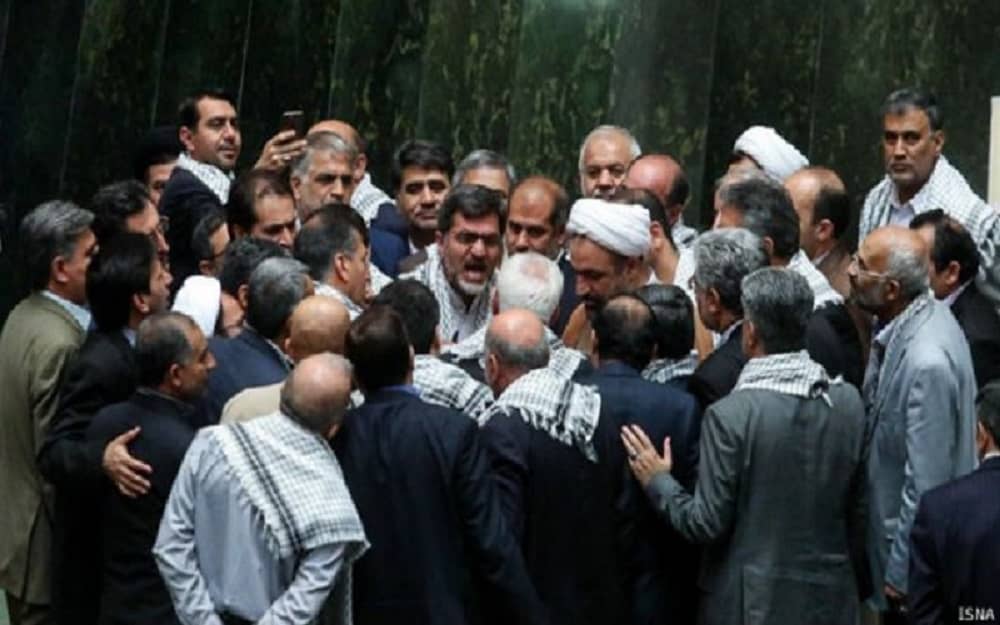
FILE PHOTO: Brawl between MPs in Iran’s parliament (Majlis)
As Iran grapples with a worsening economic crisis, intensifying international pressure, and widespread public discontent, internal divisions within the regime have become increasingly apparent. The government’s inability to present a unified stance on nuclear negotiations, coupled with deep-seated corruption and policy failures, has exposed a leadership in disarray, struggling to maintain control.
Contradictions in Nuclear Diplomacy
The Iranian government has sent mixed signals regarding its willingness to negotiate over its nuclear program. While Iran’s delegation at the United Nations hinted that discussions could be “reviewed” if concerns about potential military dimensions were addressed, Foreign Minister Abbas Araghchi swiftly dismissed such a possibility. “There is no such thing as potential militarization of our program, and we will never negotiate under pressure,” he stated firmly. The contradictory statements reflect deep divisions within the ruling establishment on how to handle mounting diplomatic challenges, particularly as sanctions continue to cripple the nation’s economy.
State media has struggled to navigate these inconsistencies, reinforcing Araghchi’s defiant stance while avoiding mention of the UN delegation’s more conciliatory remarks. This internal discord underscores the regime’s growing difficulty in crafting a cohesive foreign policy strategy.
Judiciary Chief’s Hardline Rhetoric and Corruption Cover-ups
Judiciary Chief Gholam-Hossein Mohseni-Ejei has adopted an aggressive stance against calls for diplomatic engagement. Dismissing suggestions that negotiations with Western powers could alleviate Iran’s economic woes, he accused proponents of diplomacy of political naivety. Instead, he insisted that Iran’s financial troubles could be resolved through “domestic resources,” overlooking the systemic corruption and mismanagement plaguing the country.
Ejei also acknowledged ongoing corruption scandals, including the Debsh Tea embezzlement case, admitting that certain financial crimes have been deliberately hidden from public scrutiny for “expediency reasons.” His remarks highlight the regime’s efforts to control the narrative while deflecting blame for its economic failures.
Infighting in Parliament and Economic Mismanagement
Tensions within Iran’s parliament have reached new heights, with officials openly clashing over the government’s economic policies. Lawmakers have criticized the administration of President Masoud Pezeshkian, particularly in the wake of ministerial dismissals. Labor Minister Ahmad Meidari narrowly avoided dismissal after facing a parliamentary warning vote, reflecting the deepening divisions within the political establishment.
On March 11, MP Mehrdad Lahouti publicly condemned the government’s handling of agricultural exports, revealing that Iran had exported 15,000 tons of potatoes only to re-import 30,000 tons, calling it a “catastrophic failure” in economic planning. Meanwhile, Mostafa Nakhee raised alarms over inexplicable government-sanctioned price hikes, warning that inflation is being driven not just by profiteering but by deliberate state actions.
Other lawmakers have called for judicial action against negligent ministers, with MP Mohammad-Javad Asgari warning that failure to hold them accountable would make the government complicit in harming the Iranian people. Simultaneously, political appointments within Pezeshkian’s administration have sparked fierce disputes, with accusations that certain appointees were involved in past uprisings against Supreme Leader Ali Khamenei.
A Regime in Decline
The Iranian leadership is increasingly unable to contain the multiple crises engulfing the nation. Internal power struggles, economic paralysis, and mounting corruption scandals all point to a regime that is losing its grip on authority. With inflation soaring and public anger escalating, the ruling elite appears fractured, unable to formulate a unified response to the country’s mounting challenges.

MEK Iran (follow us on Twitter and Facebook), Maryam Rajavi’s on her site, Twitter & Facebook, NCRI (Twitter & Facebook), and People’s Mojahedin Organization of Iran – MEK IRAN – YouTu