
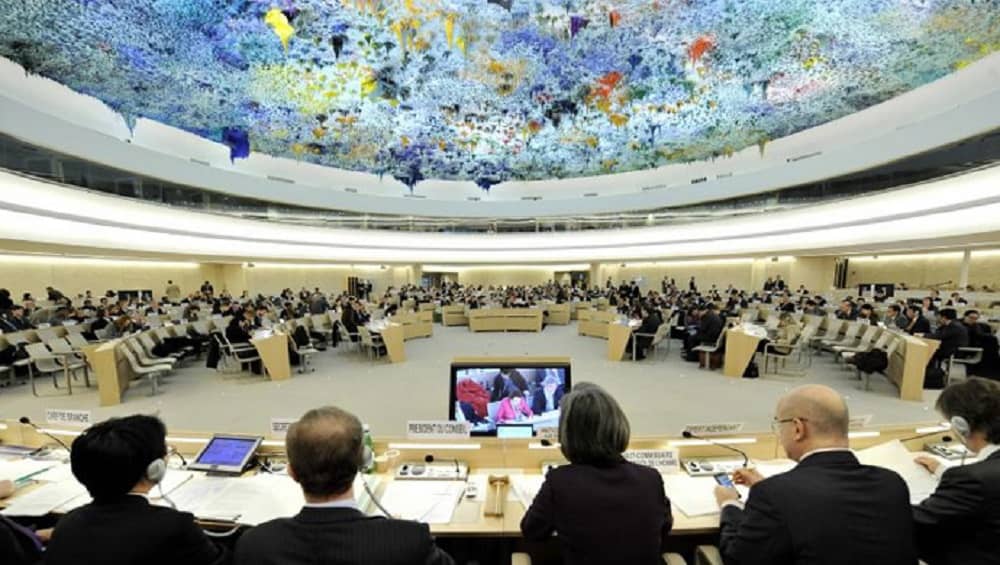
FILE PHOTO: The UN Human Rights Council.
During the 48th session of the United Nations Human Rights Council (UNHRC) on Friday, widespread international criticism was directed at Iran’s human rights record. Representatives from numerous nations condemned systemic abuses, including the repression of women, the extensive use of the death penalty, and the stifling of civil liberties.
Spain led the charge, expressing profound concern over Iran’s treatment of women and minorities, while advocating for the abolition of the death penalty. Spanish delegates called for an immediate end to all forms of discrimination and repression, urging Tehran to align its policies with global human rights standards.
Sweden echoed these concerns, highlighting the regime’s extensive use of the death penalty, even against minors. The Swedish representative called for compliance with Article 9 of the International Covenant on Civil and Political Rights, demanding the release of arbitrarily detained individuals and an end to systemic gender-based abuses.
At #UPR48 🇬🇧@ESandersFCDO expressed deep concerns over its human rights record, recommending the following:
1️⃣ Guarantee all individuals fair trials, especially in death penalty cases, with obligations under #ICPPR
2️⃣ Grant access to @UN_HRC mandate holders, incl. the special… pic.twitter.com/0uHZHMHGui— IRAN HRM (@IranHrm) January 25, 2025
Ukraine drew attention to Iran’s complicity in the ongoing conflict in Ukraine, emphasizing the regime’s use of drones to attack civilians and critical infrastructure. Labeling these actions as violations of international humanitarian law, Ukrainian representatives urged Tehran to cooperate with fact-finding missions and halt its support for aggression. The United Kingdom condemned the violent enforcement of Iran’s mandatory hijab laws and its persecution of human rights defenders and journalists. British delegates also criticized the Iranian regime’s discriminatory practices against ethnic and religious minorities, urging greater accountability and reform.
Germany voiced similar concerns, lamenting Iran’s high execution rates and lack of fair trials. The German representative called for the abolition of capital punishment and demanded protections for vulnerable groups, including women and minorities. Other nations, including Estonia, France, Italy, Ireland, Finland, and Switzerland, joined in condemning the regime’s escalating human rights violations. Their representatives spotlighted Iran’s rising execution rates, particularly targeting minors, and the pervasive oppression of women and girls. Estonia also criticized Iran’s refusal to cooperate with the UN’s independent fact-finding mission.
On January 24, Amb. Magnus Hellgren from @SwedenUN presented its first 2 recommendations to Iran at #UPR48 @UN_HRC:
1️⃣ Introduce a moratorium on the death penalty, including for juvenile offenders, aiming for abolition.
2️⃣ Eliminate, in law and practice, all forms of systematic… pic.twitter.com/Q3crvidakU— IRAN HRM (@IranHrm) January 25, 2025
The session underscored mounting global frustration with Tehran’s persistent defiance of international norms. Nations called on Iran to engage meaningfully with international bodies, implement substantive reforms, and honor its commitments under international law. Without immediate action, delegates warned, Iran risks further alienation on the world stage. This collective denunciation reflects a growing global consensus on the urgent need for accountability and reform in Iran to address its alarming human rights abuses.

MEK Iran (follow us on Twitter and Facebook), Maryam Rajavi’s on her site, Twitter & Facebook, NCRI (Twitter & Facebook), and People’s Mojahedin Organization of Iran – MEK IRAN – YouTu