
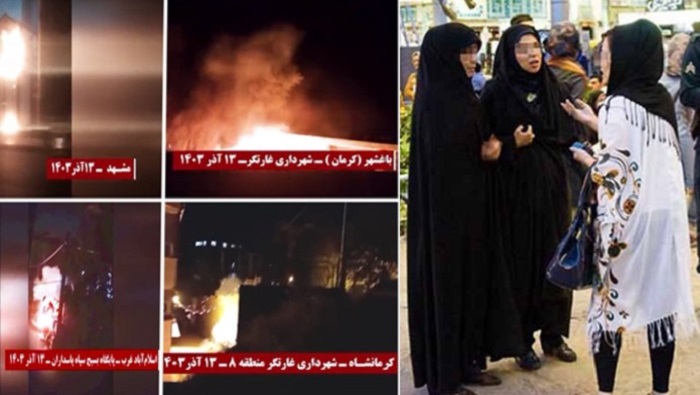
On December 3, 2024, Iran witnessed a wave of defiance against the regime’s repressive “Chastity and Hijab Law,” as rebellious youth launched targeted attacks on symbols of oppression across the country.
The controversial law, which intensifies control over women and imposes draconian penalties for defiance, has sparked widespread outrage, with slogans such as “No to compulsory hijab, no to forced religion, and no to mandatory government” echoing throughout Iranian cities.
In a series of coordinated acts of resistance, protesters targeted regime buildings and propaganda installations in multiple cities, including Kerman, Kermanshah, and Tehran. Explosions were reported at regime facilities in Bagh Shahr and Kermanshah’s District 8, while Basij bases in Eslamabad-e Gharb, Homayounshahr, and Bushehr were set ablaze. Protesters also burned banners featuring regime leaders and symbols of repression, such as Qassem Soleimani, a prominent figure in the Iranian Revolutionary Guard Corps (IRGC).
Adding to the resistance, slogans advocating “Woman, Resistance, Freedom” were projected in cities like Rasht, Karaj, and Mashhad, defying the heavy surveillance of IRGC cameras. This phrase has become emblematic of women’s central role in the fight for liberty, particularly since the 2022 uprising.
In Evin Prison, female political prisoners also raised their voices against the regime. Protesting the execution of six political prisoners, they chanted slogans like “Freedom shall never perish” and “Our response to executions is fire, rage, and uprising.” Their defiance within the confines of one of Iran’s most notorious prisons reflects the enduring spirit of resistance.
The “Chastity and Hijab Law,” passed on November 30, 2024, enforces strict dress codes and mandates severe punishments for non-compliance. Penalties extend beyond women to include business owners, employees, and public servants who fail to enforce or report violations. These measures have drawn sharp criticism for violating international human rights standards, including the Universal Declaration of Human Rights and conventions on women’s rights.
Mrs. Maryam Rajavi, president-elect of the National Council of Resistance of Iran (NCRI), condemned the law, urging Iranians to resist. “Rise up and let the world hear this cry: No to compulsory hijab, no to forced religion, no to mandatory government,” she declared, emphasizing the necessity of overthrowing the regime. As Iran’s youth and women lead the charge against oppression, their resilience symbolizes hope for a freer future. The fight against the “Chastity and Hijab Law” underscores a broader struggle for human rights and equality, resonating with growing global support.

MEK Iran (follow us on Twitter and Facebook), Maryam Rajavi’s on her site, Twitter & Facebook, NCRI (Twitter & Facebook), and People’s Mojahedin Organization of Iran – MEK IRAN – YouTu