
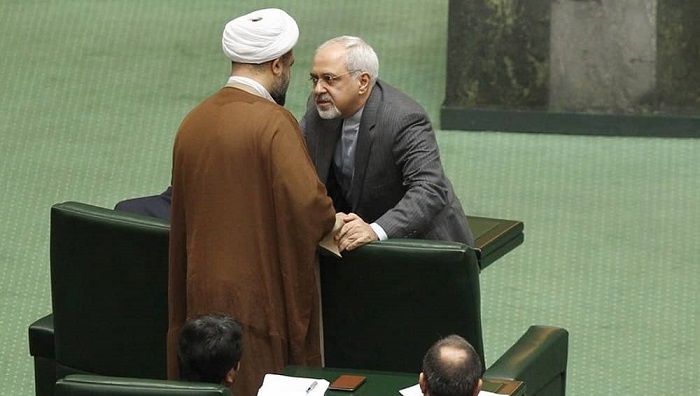
The debate surrounding dual nationality among Iranian government officials has intensified, exposing deep fractures within the nation’s ruling factions.
At the heart of the controversy is the administration of President Massoud Pezeshkian, which has come under fire from the hardline Jebheh Paydari faction. The faction accuses Pezeshkian’s government of appointing officials with family members holding dual nationality, a move they claim undermines Iranian law and sovereignty.
The controversy was reignited by the appointment of Mohammad Javad Zarif, whose family’s dual nationality provoked a fierce backlash from members of parliament. Leading the charge were MPs Hamid Rasaee, Mehdi Kuchakzadeh, and Kamran Ghazanfari, who demanded Zarif’s removal and threatened legal action against the president. Ghazanfari’s rhetoric escalated further, suggesting that Pezeshkian’s continued support for Zarif could warrant impeachment.
Despite indications from Supreme Leader Ali Khamenei’s office of potential leniency on the contentious legislation, the Jebheh Paydari faction has refused to budge. Excluded from Pezeshkian’s coalition government, the faction has positioned itself as a staunch defender of legal integrity and national interests.
Parliamentary Outcry
The debate came to a head on December 3, when Jebheh Paydari MP Qasem Ravanbakhsh accused Zarif of violating the 2021 law prohibiting dual nationals from sensitive roles. Ravanbakhsh decried Zarif’s role in ongoing negotiations, claiming parliament was being sidelined on critical matters like missile development and nuclear talks. Similarly, Rasaee called for Vice President Aref’s dismissal due to his child’s U.S. citizenship, demanding adherence to the law.
Factional Clashes over Zarif’s Appointment Expose Deep Divisions in #Iran’s Regimehttps://t.co/PX6DZXxD10
— NCRI-FAC (@iran_policy) November 28, 2024
Adding fuel to the fire, MP Amirhossein Sabati alleged that several other vice presidents in Pezeshkian’s administration also had family members with dual nationality. Calls for an investigation by the Inspector General’s Office have amplified the pressure.
Zarif: Unyielding Amid Opposition
Zarif has remained defiant, asserting that his continued service was at Pezeshkian’s direction. “I prefer not to engage in these discussions,” he stated, emphasizing his focus on fulfilling his duties. Critics, however, see this as a provocation. Speaker Mohammad Baqer Ghalibaf has publicly suggested Zarif step aside until legal ambiguities are resolved.
Broader Implications
The controversy highlights a larger struggle between Iran’s executive and legislative branches. Jebheh Paydari’s influence was evident in a decisive parliamentary vote rejecting amendments to the dual nationality law. This friction reflects diminishing deference to Khamenei’s authority and growing factionalism.
Factional Feud Escalates in #Iran Over Zarif Appointment Amid Domestic and Regional Criseshttps://t.co/iO5uhIMyvv
— NCRI-FAC (@iran_policy) October 23, 2024
Farhikhtegan, a newspaper aligned with Khamenei’s advisor Ali-Akbar Velayati, has warned against overzealous enforcement of the law. It cautioned that such actions risk economic repercussions, including capital flight. The paper urged factions to prioritize national interests over partisan agendas, warning that missteps could weaken Iran’s sovereignty.
As the standoff continues, the stakes extend beyond Pezeshkian’s administration. Whether the Supreme Leader intervenes to broker a resolution remains to be seen. What is clear, however, is that this power struggle could have profound implications for Iran’s political stability amid mounting domestic and international pressures.

MEK Iran (follow us on Twitter and Facebook), Maryam Rajavi’s on her site, Twitter & Facebook, NCRI (Twitter & Facebook), and People’s Mojahedin Organization of Iran – MEK IRAN – YouTu