
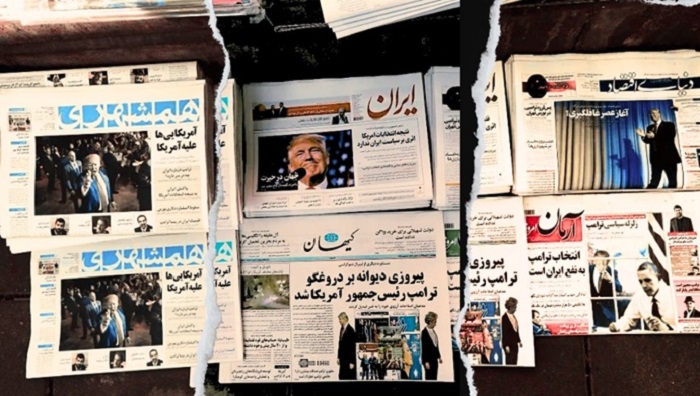
As discussions around Donald Trump’s return to power continue to unfold, Iranian government officials and media are presenting divided perspectives on how this shift could impact Iran’s economy and regional security.
While some leaders downplay the impact of U.S. elections, others caution that a renewed Trump administration could bring intensified economic pressure and a more unstable Middle Eastern environment. Fatemeh Mohajerani, spokesperson for the government under Vice President Masoud Pezeshkian, responded to media questions, asserting that “the election of the U.S. president doesn’t hold much direct relevance for us.” Mohajerani argued that sanctions have fostered resilience within Iran’s domestic economy, and that preemptive policies mitigate potential shifts in U.S. leadership. He maintained, “Necessary plans have been set in advance, so it doesn’t greatly matter who becomes the U.S. president.”
However, this official stance appears to clash with the tone of various regime-aligned media outlets, many of which forecast a harsher reality. The state-run website Asr-e Iran published a piece on November 6 titled “Why is Trump More Dangerous than Four Years Ago?” The article argued that Trump’s past actions—including his withdrawal from the Joint Comprehensive Plan of Action (JCPOA), the targeted killing of Qasem Soleimani, and a sharp reduction in Iran’s oil exports—signal a probable increase in hostility and pressure on Iran. It suggested that Trump’s policies would likely be even more detrimental to Iran’s oil-based economy, warning that “with his increased power and experience, Trump is likely to quickly intensify pressure on Iran.”
Adding to the debate, an article in the government-linked newspaper Etemad voiced concerns about a potential 10% spike in the dollar rate if Trump regains office, with direct impacts on Iran’s oil sector. During Trump’s previous term, Iran’s oil exports plunged to under 500,000 barrels per day, a record low which strained the economy heavily. The Setareh Sobh newspaper furthered these concerns in a piece titled “The Unwritten Alliance,” speculating on heightened risks of conflict between Iran, Israel, and the U.S. if regional alignments shift, noting how Iran’s former allies are distancing themselves amid rising tensions.
A government expert, reflecting on the missed opportunities of the Biden era, expressed regret that Iran’s engagement with the U.S. had yielded minimal gains under the Democrats. “The problem lies not with the U.S. but with unresolved issues within our own country,” the expert stated, highlighting the challenges Iran faces, both internally and internationally, as U.S. policy towards Iran remains in a state of flux.
This range of perspectives reveals deep divisions within Iran on how a potential Trump victory might shape its future, underscoring both resilience and apprehension within the country’s leadership.
