
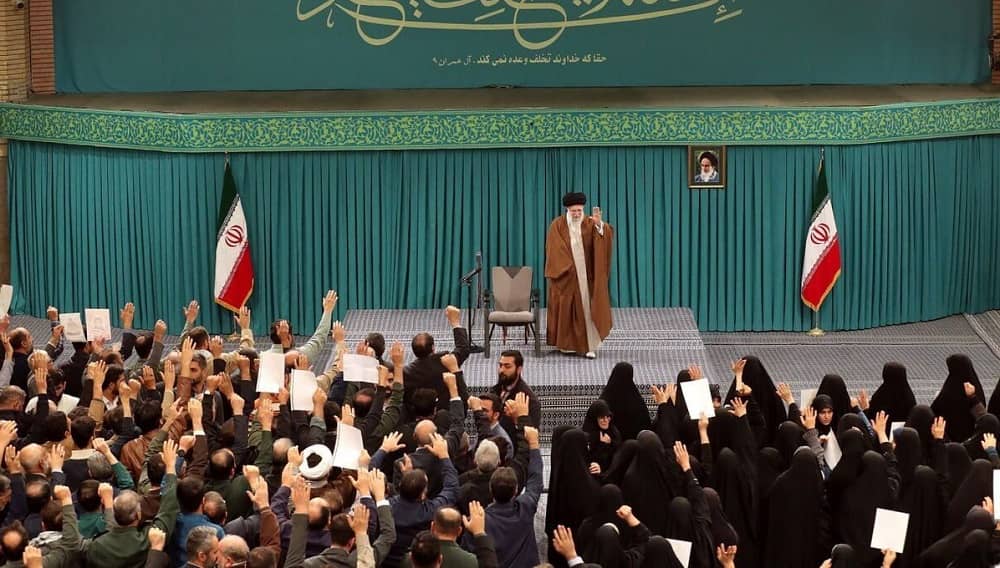
Iran’s Supreme Leader, Ali Khamenei, addressed the nation on October 27, a day after Israeli airstrikes targeted military installations within Iran.
His speech, carefully choreographed and directed at families of fallen security officers, has been widely seen as a signal of rising anxiety within the regime over both internal stability and its regional strategy. As Iran faces escalating internal resistance and fraying morale among allies, Khamenei’s rhetoric reflected his concern over preserving security and loyalty amid societal unrest.
Emphasis on Security and Unity
Khamenei openly addressed the country’s “intense societal resistance,” acknowledging, albeit indirectly, the dissent pervading social media and the streets. “Wherever there is no security, there is chaos,” he said, in a thinly veiled justification for the government’s continued repression. Highlighting the role of security forces such as the Basij and intelligence agencies, he warned against any actions that could erode this foundation, painting a picture of disorder that would justify strict control measures.
#Iranian Supreme Leader’s Speech Was A Desperate Attempt to Mask Weakness, Justify Crimes, and Warn of Infiltrationhttps://t.co/pZIhpwcg3f
— NCRI-FAC (@iran_policy) September 26, 2024
In an apparent attempt to discourage domestic criticism, Khamenei underscored the importance of power-building, refuting suggestions to scale back Iran’s regional ambitions. “Whenever our leaders in the past turned away from power-building, enemies dominated us,” he stated, emphasizing the need for a strong stance in the face of pressure from powerful foreign nations.
Balancing Internal and External Pressures
Addressing Israel’s airstrike, Khamenei avoided direct threats of retaliation, instead cautioning against both overestimating and underestimating its significance. He seemed to be acknowledging both the calls for an immediate response and the voices urging caution, striking a careful balance to prevent inflaming public discourse or creating a rift within his ranks. By assigning responsibility for any response to his officials, Khamenei deflected direct accountability, a strategy that allows him to sidestep repercussions while signaling strength.
#Khamenei’s Friday Prayer Sermon Exposes #Iranian Regime’s Fears of Regional Strategy Collapsehttps://t.co/N4iMAAbqXp
— NCRI-FAC (@iran_policy) October 4, 2024
Speaker of Parliament Mohammad Bagher Ghalibaf’s comments echoed this cautious approach, emphasizing that any response would be “decisive, with due consideration.” Similarly, President Massoud Pezeshkian’s remark, “We do not seek war but will defend our rights,” hinted at a preference for backdoor diplomacy while keeping options open.
A Shift in Rhetoric
Appealing to the broader Islamic world, Khamenei shifted his tone, advocating for a global coalition against Israel. He urged for a “political, economic, and, if necessary, military coalition” to counter what he described as Israeli war crimes, signaling both his concern over weakening regional alliances and his hope to rally broader support for his regime’s goals. Khamenei’s speech reflects a struggle to maintain control amid waning influence, underscoring the continued regional instability fueled by Iran’s ruling clerical regime.
