
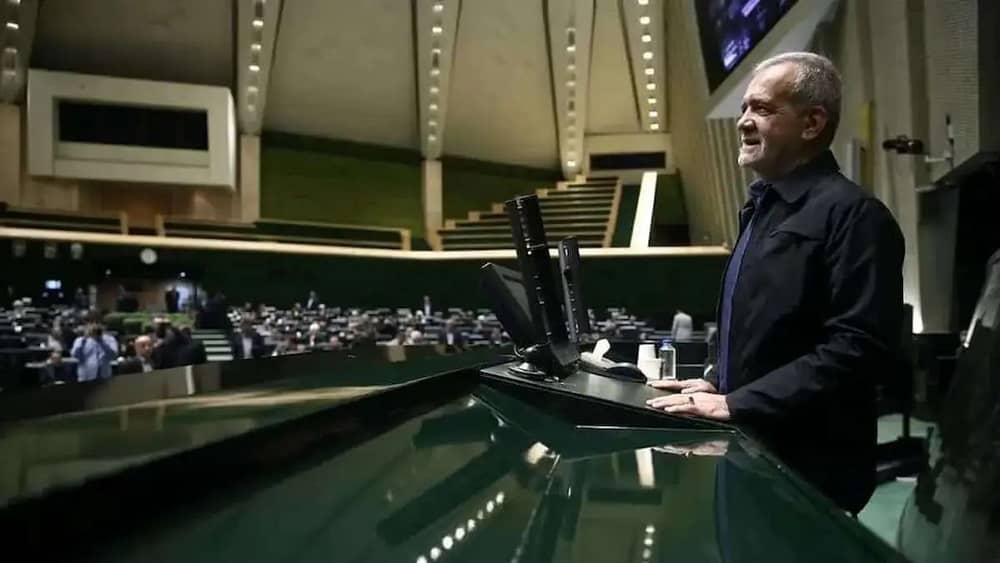
In a turbulent parliamentary session on August 17, newly inaugurated President Masoud Pezeshkian encountered intense resistance from factions within the clerical establishment, highlighting deep divisions and power struggles within the regime.
The session, which centered around the approval of Pezeshkian’s proposed cabinet, revealed the underlying fractures in the political landscape. Pezeshkian, wearing his symbolic “protest cap” reminiscent of his campaign days, delivered a critical speech that pointed to the country’s severe socio-economic issues. He addressed widespread public dissatisfaction, poverty, corruption, and injustice, attributing these problems to the mismanagement by the ruling system rather than external forces. “The root of this discontent lies in the policies and management of the system,” Pezeshkian asserted. However, his remarks were met with impatience and frustration from various factions within the assembly.
As he emphasized the importance of national unity and loyalty to the Supreme Leader’s vision, Pezeshkian acknowledged the dire state of the nation. He described the country as being “in a critical condition,” with widespread economic hardships exacerbated by corruption and flawed patronage networks. His warning that the government stood “at the edge of a fire” if the people’s voices were not heard underscored the urgency of addressing the public’s growing frustration and distrust in the government.
Internal Rifts Deepen in Iran as #Pezeshkian’s Cabinet Faces Backlash from All Sideshttps://t.co/E8yVtdIS9U
— NCRI-FAC (@iran_policy) August 16, 2024
Despite his calls for unity, Pezeshkian’s address was met with sharp criticism. Hamid Aboutalebi, a political advisor to former President Hassan Rouhani, lambasted the speech as “tedious” and full of mistakes, questioning Pezeshkian’s competence in communication. Hardline MP Hamid Rasaee echoed these sentiments, accusing Pezeshkian of repeating the same rhetoric from previous speeches without defending his cabinet adequately.
Contentious debate arose over Pezeshkian’s ministerial nominations, particularly the proposed ministers for Health and Foreign Affairs, and the controversial nomination of Eskandar Momeni as Minister of Interior. The latter appointment was widely seen as a concession to the influential Speaker of Parliament, Mohammad Bagher Ghalibaf.
Further criticism was leveled at Pezeshkian for failing to present a comprehensive government program alongside his ministerial nominations, a requirement under parliamentary protocol. MPs questioned the legality of the session and expressed disappointment over the lack of a distinct plan beyond reiterating the Supreme Leader’s directives.
#Iranian Regime’s Factions Erupt in Conflict Over Pezeshkian’s Controversial Cabinet Choiceshttps://t.co/JDqRZ8PHIB
— NCRI-FAC (@iran_policy) August 14, 2024
As the first day of debates drew to a close, it became clear that Pezeshkian’s administration faced significant challenges. His ability to navigate the deep-seated divisions within the parliament and address the broader socio-political concerns will be crucial in determining the future stability of his presidency. The session underscored not only the growing discontent within the regime but also the complex and volatile political environment that Pezeshkian must now steer through.

MEK Iran (follow us on Twitter and Facebook), Maryam Rajavi’s on her site, Twitter & Facebook, NCRI (Twitter & Facebook), and People’s Mojahedin Organization of Iran – MEK IRAN – YouTu