
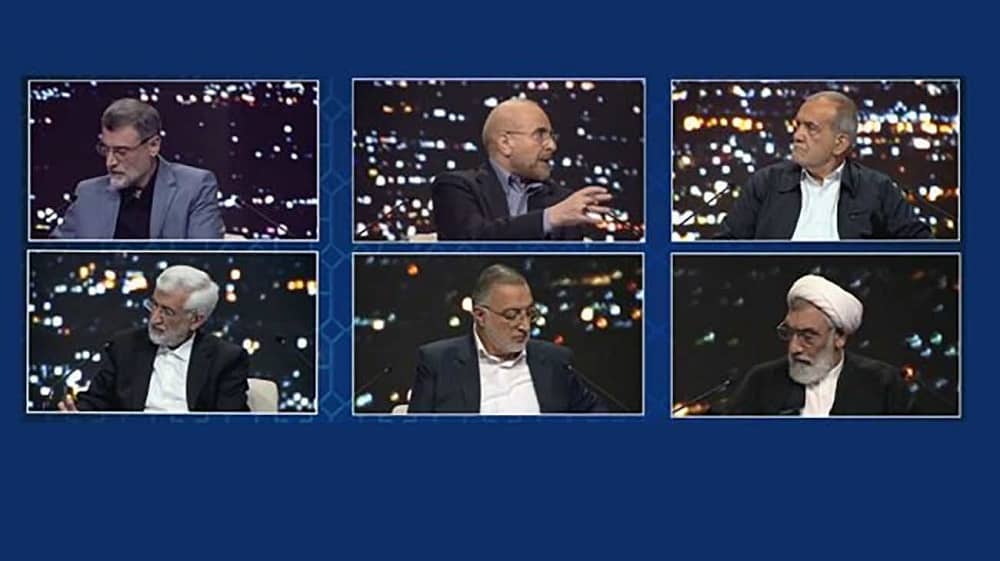
The fourth televised debate preceding Iran’s presidential elections underscored the profound divisions and fervent rhetoric among the six Guardian Council-approved candidates vying to replace Ebrahim Raisi.
Titled “Iran in Today’s World,” the three-hour debate focused on international relations, unveiling stark contrasts in the candidates’ perspectives. This debate occurred despite Supreme Leader Ali Khamenei’s admonition to avoid “enemy-pleasing” commentary and mutual exposure.
Candidates Clash on Key Issues
Masoud Pezeshkian, labeled a reformist by the regime, emphasized the nation’s military prowess, stating, “Our defensive power is a source of pride. The deterrent capabilities of our country and the efforts of the Revolutionary Guard and the army are commendable.” Pezeshkian candidly acknowledged systemic mismanagement and economic woes, highlighting issues like seasonal gas and electricity shortages and the loss of investment opportunities. He challenged Saeed Jalili and others to offer alternative solutions if they opposed reviving the JCPOA.
Amir-Hossein Ghazizadeh Hashemi praised Raisi’s administration as a panacea for the country’s troubles. He argued that the threat from the US, whether under Biden or Trump, is dwarfed by internal obstructions to oil revenue. Ghazizadeh criticized promises to lift sanctions, deeming them futile, as sanctions are ingrained in US security strategy.
Mohammad Bagher Ghalibaf frequently invoked the legacy of Qassem Soleimani, asserting that threats could be transformed into opportunities. He criticized Pezeshkian’s potential administration, equating it with Hassan Rouhani’s, and warned of a regression to past conflicts and governance disruptions.
Mostafa Pourmohammadi linked the disqualification of key political figures to the election’s lackluster atmosphere. He criticized Jalili for opposing organized political activities and NGOs, suggesting such views might incite “color revolutions.” Pourmohammadi also accused Jalili of blocking corruption case resolutions, specifically referencing the Crescent Petroleum scandal.
#Khamenei Warns Against 'Enemy-Pleasing' Remarks, While Candidates Clash in #Iran's Third Sham Presidential Election Debatehttps://t.co/CaBow9KN7F
— NCRI-FAC (@iran_policy) June 22, 2024
Saeed Jalili rebutted Pourmohammadi’s accusations, asserting that decisions should not be based on “hallway gossip.” He argued that solely focusing on negotiations would not prevent sanctions and criticized Rouhani’s administration for missing regional commercial opportunities.
Alireza Zakani lambasted Rouhani’s administration, highlighting foreign policy failures and the JCPOA’s handling. He claimed Iranians faced humiliation abroad and reiterated his willingness to debate corruption issues, particularly the Crescent Petroleum case.
Consequences and Reflections
Abdolreza Davari, former advisor to Mahmoud Ahmadinejad, tweeted criticism of Jalili’s debate performance, praising Pourmohammadi for exposing Jalili’s ambitions. The debate highlighted voter disillusionment, with a state-affiliated journalist noting the unprecedented lack of social enthusiasm since the 2021 elections.
The state-run newspaper Etemad criticized the debates for dampening electoral excitement, reflecting the low level of candidate knowledge and capability. Former president Hassan Rouhani condemned a recent parliamentary law, accusing its creators of economic sabotage against his administration.
As the election day nears, the divisions among presidential candidates and their factions deepen. Despite Khamenei’s efforts to maintain regime stability, the debates reveal internal fractures and vulnerabilities, unintentionally exposing the regime’s profound weaknesses.

MEK Iran (follow us on Twitter and Facebook), Maryam Rajavi’s on her site, Twitter & Facebook, NCRI (Twitter & Facebook), and People’s Mojahedin Organization of Iran – MEK IRAN – YouTu