
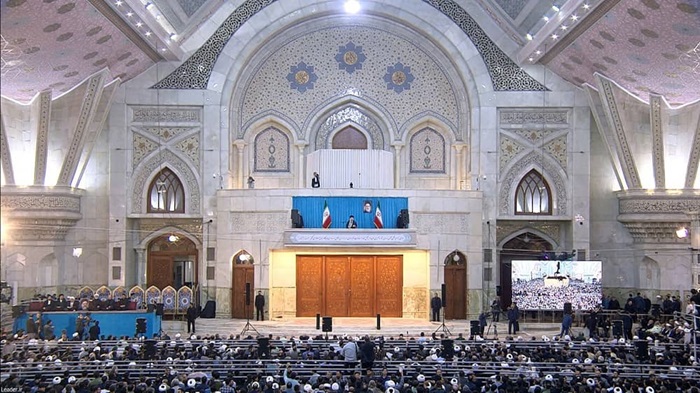
Fifteen days following the death of Ebrahim Raisi, the favored president of Iran’s Supreme Leader Ali Khamenei, Khamenei used the anniversary of his predecessor Ruhollah Khomeini’s death to address both a restive society and the international community.
In his speech to hand-picked regime loyalists, he attempted to project undiminished power and influence over regional and global affairs. During the address, Khamenei expressed satisfaction with the ongoing Gaza conflict, which has caused significant bloodshed and heightened global tensions. He proclaimed, “The miraculous Operation Al-Aqsa Storm thwarted the enemies’ grand plan to dominate the region and the Islamic world.” This operation, according to Khamenei, disrupted efforts by America, Zionists, and their allies to exert control over the region.
Khamenei’s rhetoric highlighted his fear of regional isolation and his need to present a strong front. He emphasized that the operation on October 7 was necessary and timely for the region, positioning it as a vital response to external threats. His statements underscored a narrative of resistance and defiance against perceived adversaries.
In a tribute to Raisi, whom he referred to as a “martyr of service,” Khamenei acknowledged the former president’s unpopularity. He claimed that despite Raisi’s significant contributions, he was often misrepresented and underappreciated. Khamenei used this as a lesson for future leaders, stressing the importance of clear stances against the enemies of the revolution.
Watch a 7 min recap of:
Crisis and War in the #MiddleEast: The Roots and Solutions
Understanding the #Iranian regime’s Goals in the Crisis pic.twitter.com/oikos96Kxu— NCRI-FAC (@iran_policy) January 2, 2024
Khamenei also addressed concerns over a potential nationwide boycott of upcoming elections, emphasizing the regime’s need to demonstrate strength. He pointed to the massive turnout at state ceremonies for Raisi and other officials who died in a helicopter crash, framing it as evidence of a strong emotional bond between the people and the regime.
Looking ahead to the next presidential election on July 8, Khamenei called for a high turnout to showcase the regime’s power. He stressed the need for a dynamic and committed president who aligns with revolutionary principles and can address Iran’s complex challenges. He warned against internal power struggles, urging officials to avoid slander and accusations that damage national dignity.
Khamenei’s speech comes at a time of significant internal and regional challenges. With the loss of key officials and ongoing power struggles within his regime, he faces the daunting task of managing an explosive domestic situation and a war-torn region. His defiant stance and calls for unity and strength reveal the precarious balance he must maintain.
Amid Dual Election Turmoil, Clash of Clans Escalate Within #Iran’s Regimehttps://t.co/nq8c6ZNMvA
— NCRI-FAC (@iran_policy) May 30, 2024
In contrast, the Palestinian presidency responded to Khamenei’s remarks by rejecting the need for wars that do not serve their ambitions for freedom and independence. They criticized his statements as sacrificing Palestinian blood without furthering the establishment of an independent Palestinian state. Khamenei’s speech highlights the ongoing tensions and complexities within Iran and its regional policies. While projecting strength, it also reveals the underlying challenges and fears facing the regime.

MEK Iran (follow us on Twitter and Facebook), Maryam Rajavi’s on
her site, Twitter & Facebook, NCRI (Twitter & Facebook),
and People’s Mojahedin Organization of Iran – MEK IRAN – YouTu