
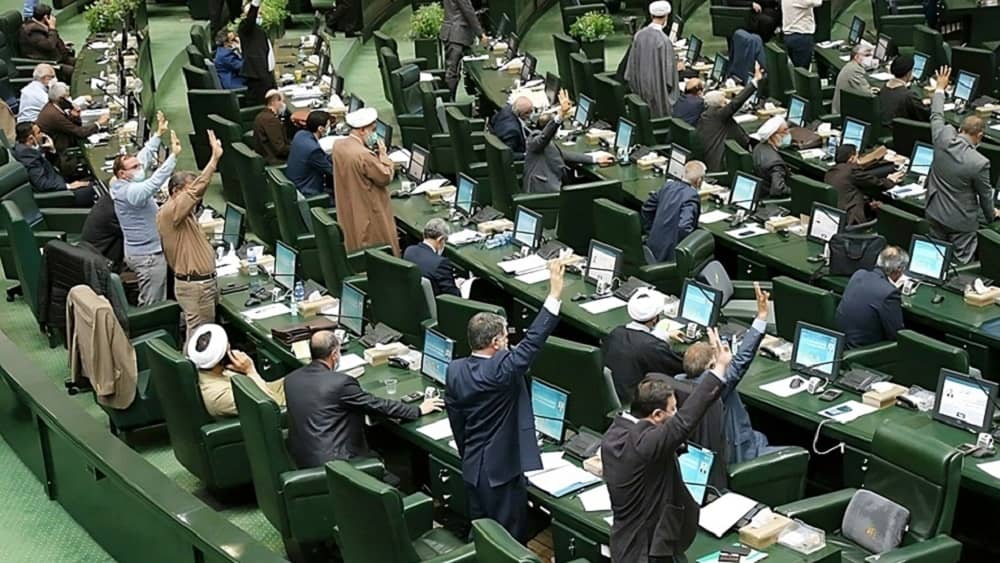
The sudden death of Iranian President Ebrahim Raisi in a helicopter crash on May 19 has intensified the already fierce power struggle within the regime.
As the crisis-ridden government braces for another election in less than 50 days, which is expected to face widespread boycotts by the Iranian populace, the nation is witnessing a surge in factional conflicts and corruption revelations.
In the waning days of the current parliament, the competition for influential positions in the upcoming formation has uncovered significant corruption scandals. Under the leadership of Mohammad Bagher Ghalibaf, incriminating documents have surfaced, exposing financial misdeeds within the Masaf Institute, an organization linked to Ali Akbar Raefipour, a close ally of Supreme Leader Ali Khamenei. These documents revealed the transfer of billions of tomans to the accounts of Raefipour’s family members.
State-controlled media have highlighted these financial irregularities. Entekhab reported an unexplained withdrawal of 8 billion tomans from the Masaf Institute’s account, while Eghtesad24 accused the institute of money laundering through its legal accounts. Despite Raefipour’s account holding a modest 66 million tomans, his sister’s and father’s accounts boasted nearly one billion and 1.6 billion tomans, respectively.
Systemic #Corruption and Infighting Amid Public Unrest in #Iranhttps://t.co/p5SMZvsYMG
— NCRI-FAC (@iran_policy) May 16, 2024
Entekhab further questioned the rapid movement of vast sums through the institute’s accounts, challenging the legitimacy of the transactions for an organization purportedly dedicated to religious charitable activities. Raefipour defended himself, asserting that all funds were received as donations and managed transparently. “For example, if someone donated money for purchasing rice for Arbaeen, that money is kept until Arbaeen and not spent elsewhere to avoid any religious wrongdoing,” he explained.
The controversy deepened when Raefipour accused Parliament members of bribery and corruption during a televised interview, leading to an abrupt end of his remarks by the program’s host. He recounted incidents, such as a parliamentary committee member allegedly demanding a two-billion-toman bribe to halt an investigation and another member receiving 140 gold coins in bribes.
Following these revelations, a faction of the regime’s cyber army launched a coordinated social media attack against an opposing MP who had challenged Raefipour’s accusations, signaling support for Raefipour.
Iran’s Cyber Army: A Force of Disinformation for a Cursed Causehttps://t.co/S3LusEN4HB
— NCRI-FAC (@iran_policy) April 26, 2023
This scandal is not Raefipour’s first clash with powerful regime factions. In January 2022, Khabar Online reported a conflict between Raefipour and the Seraj Organization, linked to the Islamic Revolutionary Guard Corps (IRGC), after he criticized Seraj for claiming credit and financial rewards for a hashtag campaign initiated by Masaf on Twitter. The extensive use of the regime’s cyber army, comprising entities like Seraj, Basij, Masaf, and Jangal, to manipulate public opinion through organized social media activities, often in exchange for payments, was detailed in the report.

MEK Iran (follow us on Twitter and Facebook), Maryam Rajavi’s on her site, Twitter & Facebook, NCRI (Twitter & Facebook), and People’s Mojahedin Organization of Iran – MEK IRAN – YouTu